


 Italiano
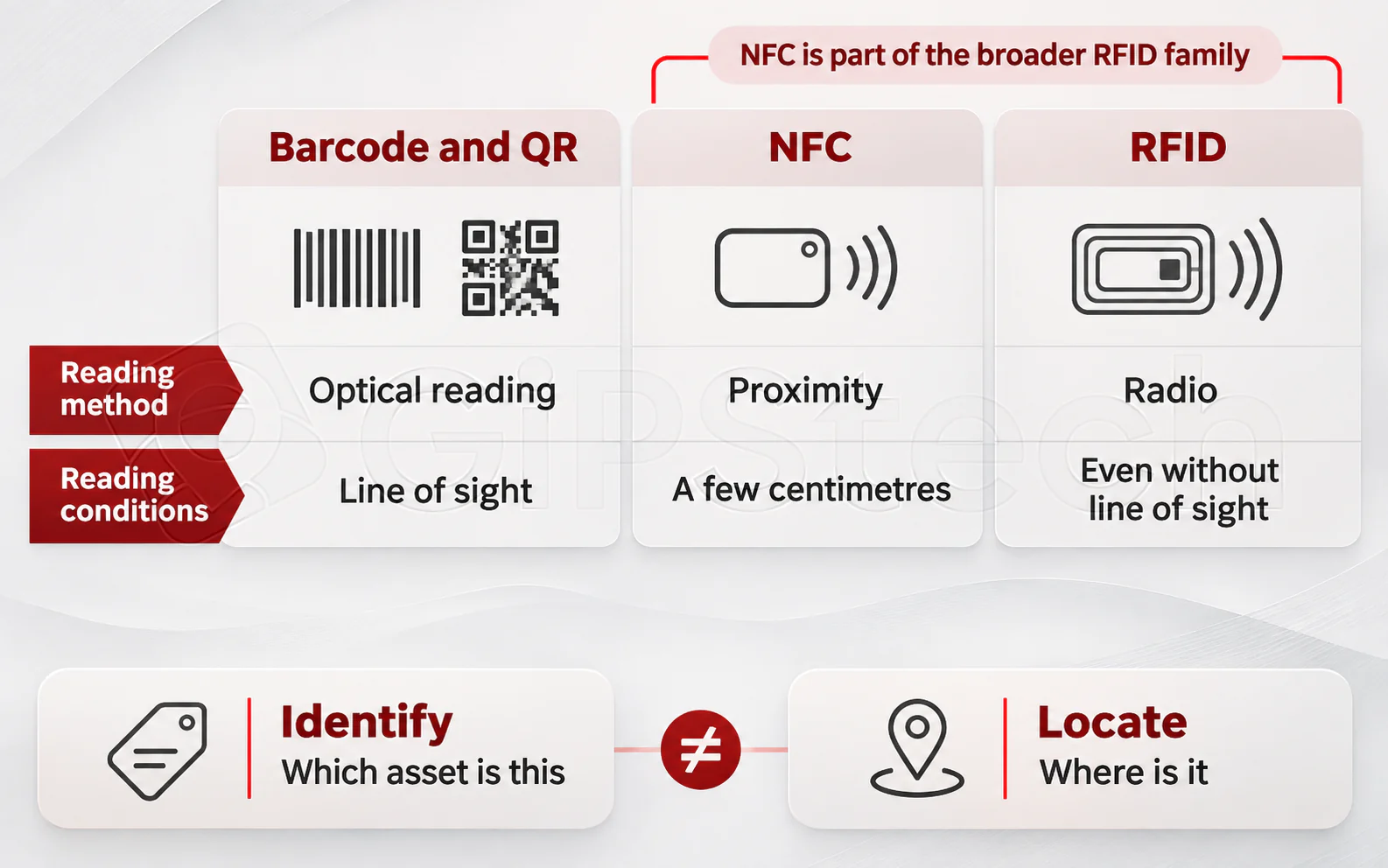
Identifying an asset means recognizing the individual item without confusing it with similar units. A label connects the physical object to its identity in the register. Barcodes, QR codes (opens in a new tab), NFC (opens in a new tab) and RFID (opens in a new tab) support different reading methods: the choice depends on the task and environment as well as the cost of the tag.
A stable identity before the technology
Section titled “A stable identity before the technology”The essential information is a unique identifier associated with the asset record. The label may contain it directly or carry a reference through which it can be retrieved. Room names and departments can change, so they should not be the only permanent identity.
Damaged, replaced and duplicate labels also need managing. Reprinting should retain the connection to the correct item; reusing a disposed asset’s code risks mixing different histories. Technology makes reading easier but cannot by itself correct an incorrect association.
Optical reading: barcodes and QR codes
Section titled “Optical reading: barcodes and QR codes”A barcode requires the symbol to be visible to the reader. The QR code, specified by ISO/IEC 18004:2024 (opens in a new tab), is a two-dimensional symbol. It can contain an identifier or a link, but its contents do not guarantee that a record is current or that the reader is authorized to access it.
Readability depends on size, contrast, lighting, distance and surface condition. These need checking on site: dirt, wear or a label behind a panel can make an otherwise simple solution awkward. Human-readable information can help when automatic reading fails.
Proximity: NFC
Section titled “Proximity: NFC”NFC (opens in a new tab) is a short-range radio technology: an operator brings a compatible device close to a tag, typically within a few centimetres. No symbol needs framing. The NFC Forum maintains specifications covering communication and data exchange, among other areas.
The reader and tag must be compatible, and positioning needs checking with the actual device. NFC on a phone does not mean it can read every RFID technology. A simple identification tag should not be treated as absolute proof of authenticity or of work having been performed.
Radio: RFID and multiple reads
Section titled “Radio: RFID and multiple reads”RFID is a family of technologies, with NFC being one particular case. Inventory scenarios also use UHF, with dedicated readers and the ability to detect multiple tags without direct optical visibility. ISO/IEC 18000-63:2026 (opens in a new tab), published in October 2026 and replacing the 2021 edition, concerns the Type C UHF radio interface; GS1 EPC (opens in a new tab) defines schemes for identification data.
This does not make range and reliability universal. Materials, orientation, shielding and reader placement require testing. It is important to understand which items were actually detected and handle missed reads or reads from an adjacent area.
An example and selection criteria
Section titled “An example and selection criteria”An imaginary laboratory needs to distinguish two identical pumps during an inspection. An accessible optical label may be sufficient. NFC may be considered where the phone should be brought close without framing a symbol. Detecting many items at a checkpoint calls for assessment of a dedicated RFID installation.
The assessment includes label material and attachment, cleaning, temperature, metal or liquids, available devices, tag replacement and reading effort. A representative sample avoids choosing solely on the basis of a demonstration in favourable conditions.
Identification is different from location
Section titled “Identification is different from location”A read tells which asset was recognized. It may record passage at a known point but does not automatically provide continuous position. Asset tracking requires clarity about update frequency, coverage and the meaning of the last known location. Identity, position and completed maintenance are different information.
Further reading
Section titled “Further reading”The technology overview introduces GiPStech positioning; the asset management page (opens in a new tab) provides the application context. For operations involving Tags, the Asset2Work documentation is reserved and requires sign-in.