


 Italiano
Condition-based maintenance uses the observed state of an asset to decide interventions; predictive maintenance adds a forecast of degradation. Installing a sensor or crossing a threshold does not by itself provide a reliable prediction. A meaningful phenomenon to observe, interpretable measurements and an organized response are needed.
UNI EN 13306:2018 (opens in a new tab) supplies the terminology framework; ISO 17359:2018 (opens in a new tab), current and confirmed in 2023, provides general guidelines for establishing a machine condition-monitoring programme.
Observe a condition
Section titled “Observe a condition”Temperature, vibration, pressure or electrical consumption can provide clues about operation. The useful parameter depends on the fault being investigated: large data volumes do not compensate for an irrelevant measurement.
Measurements may be periodic or continuous. Load conditions, sensor position, recording quality and continuity must be understood. One value may mean different things during startup and steady operation; a change may also originate in the sensor or process, rather than the asset alone.
The Internet of Things, IoT (opens in a new tab), can connect devices and measurement collection. Connectivity is a means, however: it does not itself establish whether an anomaly requires maintenance.
From a threshold to a decision
Section titled “From a threshold to a decision”The image summarizes one possible path. The arrow between alarm and intervention includes assessment and a decision: it does not mean every threshold crossing automatically produces an assignment. A threshold may require confirmation, comparison with other measurements or checking of operating conditions.
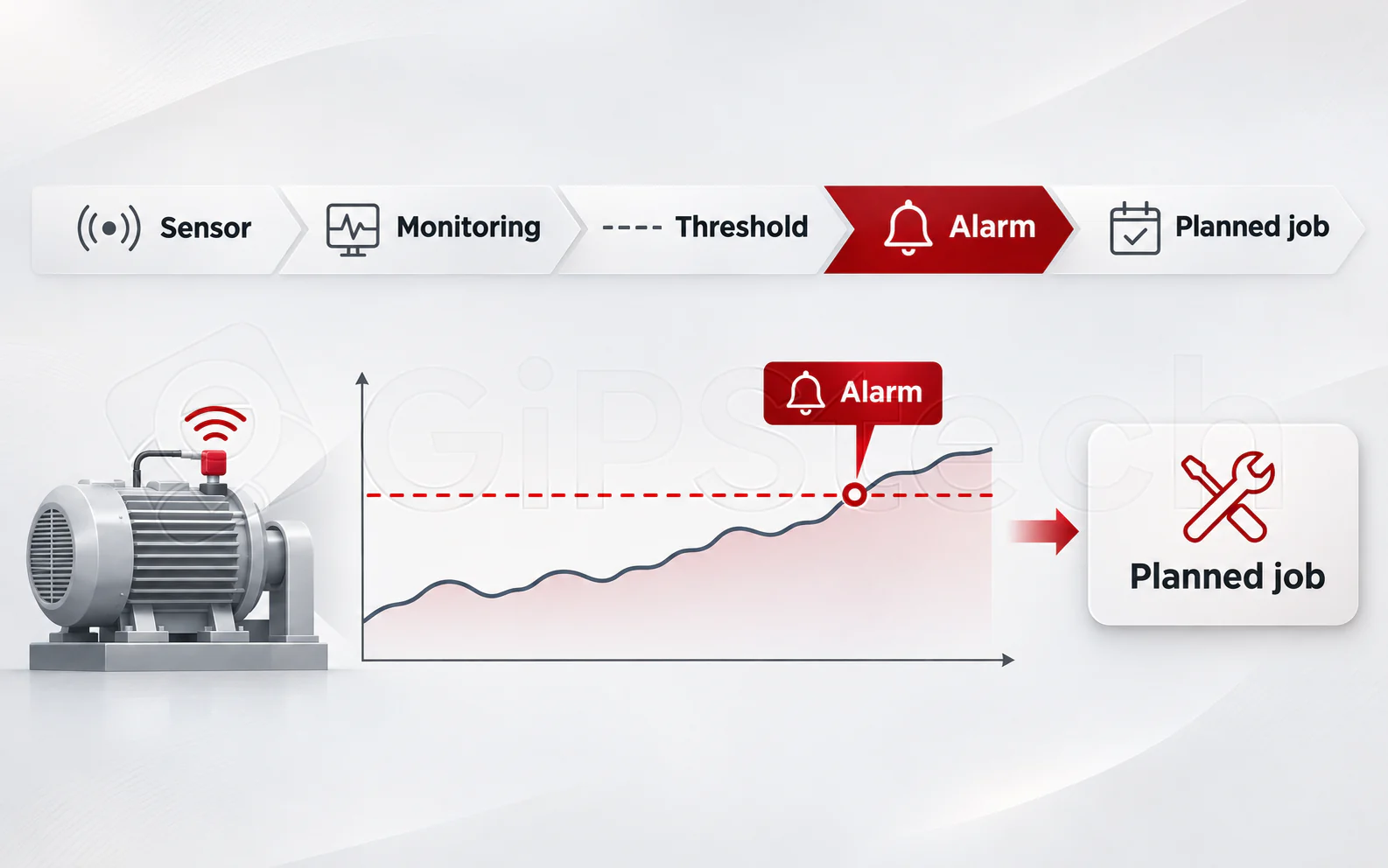
The ASHRAE operation and maintenance management handbook (opens in a new tab) distinguishes using condition measurements from forecasting based on trends over time. Exceeding a limit describes an observed condition; estimating when it will be reached requires a model or relationship supported by evidence.
What prediction adds
Section titled “What prediction adds”A forecast may help identify a maintenance window before function is lost. It must also convey uncertainty and its valid scope: usage, environmental conditions and asset modifications can change observed behaviour.
Historical data alone do not guarantee a useful model. Rare failures, missing data or unrecorded maintenance can make it difficult to distinguish a meaningful signal. Results need checking against actual outcomes, including unconfirmed alarms and undetected issues.
A fictional example
Section titled “A fictional example”Aurora observes a pump parameter under comparable conditions. A persistent change prompts a technician to inspect it. If the data show an interpretable trend, the manager can assess a work window and prepare resources and spare parts.
No threshold values or universal intervals are proposed: they must be defined for the machine and context. If the sensor stops transmitting, missing measurements do not mean good condition. The process must establish how to recognize and handle this case.
Requirements, costs and the platform’s role
Section titled “Requirements, costs and the platform’s role”Assessment includes sensors, installation, analysis tools, skills and maintenance of the monitoring system. Not every fault has usable advance signals or leaves enough time to organize a response. Interval-based preventive and corrective maintenance remain possible parts of the strategy.
Turning a signal into work requires defining who receives it, who assesses it and how the outcome is recorded. A platform should not be assumed to generate activities automatically or contain a predictive model ready for every asset. GiPStech’s industrial asset tracking and automation page (opens in a new tab) introduces the solution context; asset tracking answers a different question about position, rather than technical condition.