


 Italiano
Preventive maintenance acts before failure to limit degradation or the likelihood of losing the required function. When work follows predefined time or usage intervals, it is predetermined preventive maintenance. The challenge is choosing justified checks and frequencies for the asset and service, rather than filling a calendar.
UNI EN 13306:2018 (opens in a new tab) is the terminology reference; types of maintenance explains the relationship with corrective and condition-based maintenance. “Scheduled” instead describes how work is organized in time, rather than identifying the technical strategy by itself.
Preventive, scheduled and predictive: the differences
Section titled “Preventive, scheduled and predictive: the differences”| Term | What distinguishes it |
|---|---|
| Predetermined preventive | Work before failure follows predefined time or usage intervals. |
| Scheduled | Describes when work is organized: a corrective repair can also be scheduled if assessment of the case allows it. |
| Condition-based and predictive | The decision uses observed condition; predictive maintenance adds a forecast of how degradation develops. |
| Corrective | Work aims to restore the function after a failure is recognized. |
This distinction helps identify which information to collect. The full strategy comparison is in types of maintenance; the predictive maintenance article explores measurements, forecasts and monitoring limitations.
Bases for selecting frequencies
Section titled “Bases for selecting frequencies”An interval may depend on manufacturer instructions, operating conditions, maintenance experience and applicable requirements. Elapsed time and usage are different: identical equipment used continuously or kept as a spare may require different assessments.
Distinguish the technical requirement from the date allocated to the work. When an activity is late, moving its deadline does not resolve the need that generated it. Assess the case, document the reason and define actions with the competent responsible people.
Between too much and too little
Section titled “Between too much and too little”The image is qualitative: it illustrates the frequency problem, rather than a model for calculating deadlines. Not every check physically improves asset condition; an inspection may only observe it. Nor does every intervention restore an “as new” condition.
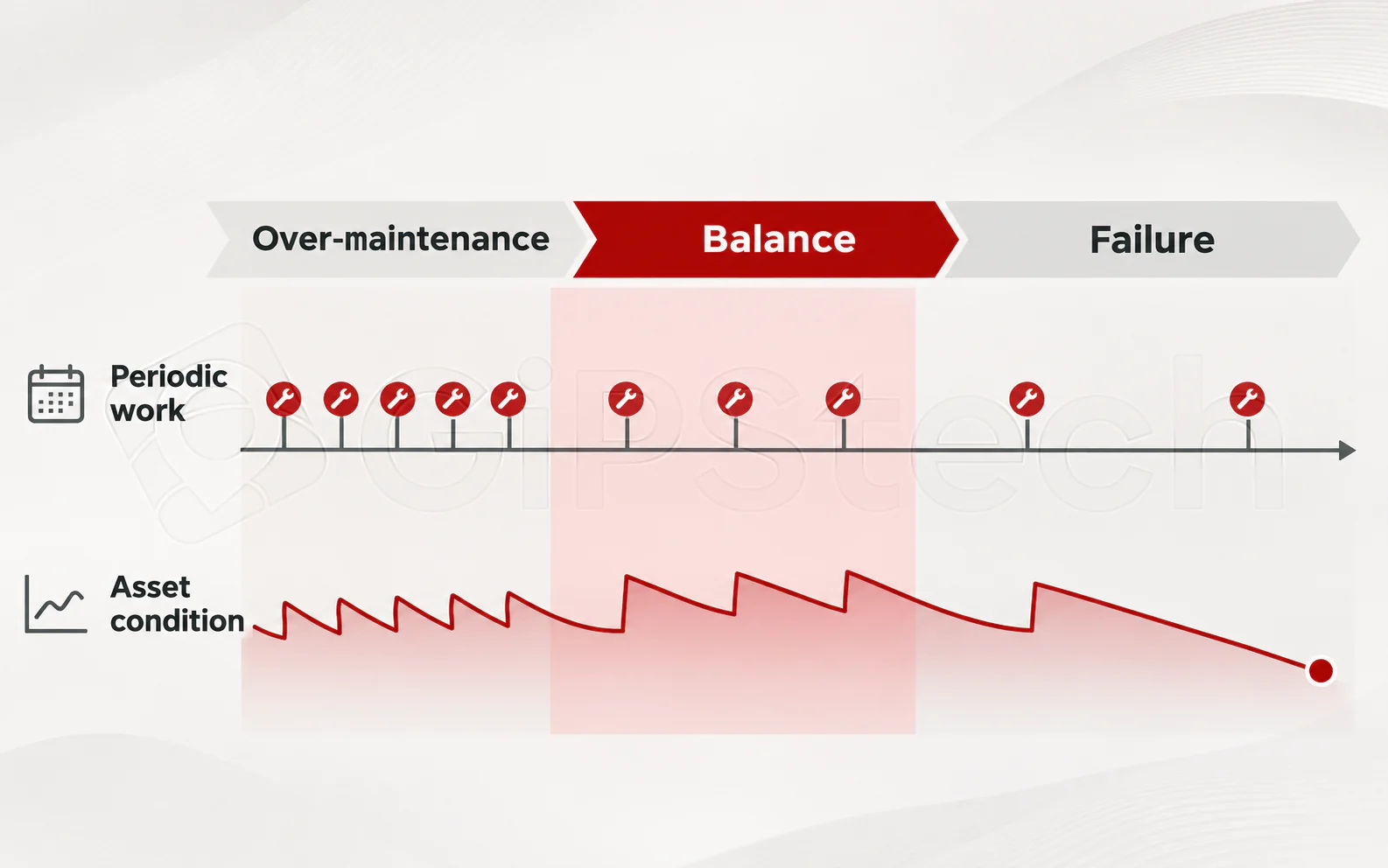
Intervals that are too long may allow degradation to develop. Unnecessary work can consume materials, require shutdowns and introduce errors during disassembly or adjustment. The aim is to justify the plan and review it using evidence, rather than indiscriminately reduce or increase interventions.
Maintenance, checks and obligations in Italy
Section titled “Maintenance, checks and obligations in Italy”For work equipment, Italian Legislative Decree 81/2008 (opens in a new tab) is an essential reference for safety, maintenance and checks. Obligations depend on equipment type and specified conditions: a software recurrence does not replace assessment of applicable requirements.
For fire protection installations, equipment and other systems, the Italian Decree of 1 September 2021 and subsequent amendments (opens in a new tab) sets criteria for inspection and maintenance. The National Fire and Rescue Service portal collects updates; the decree should not be treated as a general rule for every machine.
A maintenance intervention, a process inspection and a regulated periodic verification may require different skills, responsibilities and evidence. Identify them separately rather than infer universal intervals from an educational example.
A fictional example
Section titled “A fictional example”Aurora introduces periodic checks for a pump family. Before selecting dates, it compares documentation, usage and site conditions. The plan identifies items, checks and responsible people. After the first cycles, outcomes and anomalies inform discussion of whether the plan meets the need.
A missed check is not converted into a recorded execution. If a defect emerges, the response may require separate corrective work: preventive inspection and repair retain distinct purposes and outcomes.
To review results, maintenance KPIs distinguish failures, repairs and deadline compliance. The number of completed checks alone does not describe all these aspects.
From the plan to evidence
Section titled “From the plan to evidence”Activity planning distributes work across resources; the maintenance plan explains what to do and why; checklists organize records.
Asset2Work includes plans that generate asset-related activities using recurrences and time criteria, including a key date. The public CMMS page (opens in a new tab) introduces the scope; Task plans and tasks, reserved documentation, requires sign-in for instructions. The operational plan does not automatically certify compliance.
This educational article does not replace legal or regulatory advice: check current official texts and the requirements of the particular case.