


 Italiano
Facility management coordinates environments, people and support services so that a building can be used for its intended work. The question extends beyond who repairs equipment: users’ needs, responsibility for meeting them and the way results are checked must be clear. The scope differs between an office, a laboratory and a hospital.
Hard and soft services
Section titled “Hard and soft services”The practical distinction between hard and soft services helps readers understand a contract, but it is not a universal, rigid boundary. Hard services mainly concern buildings and their systems: maintenance, heating and cooling, fire safety and energy management. Soft services support everyday use: cleaning, reception, security guarding and the organization of space.
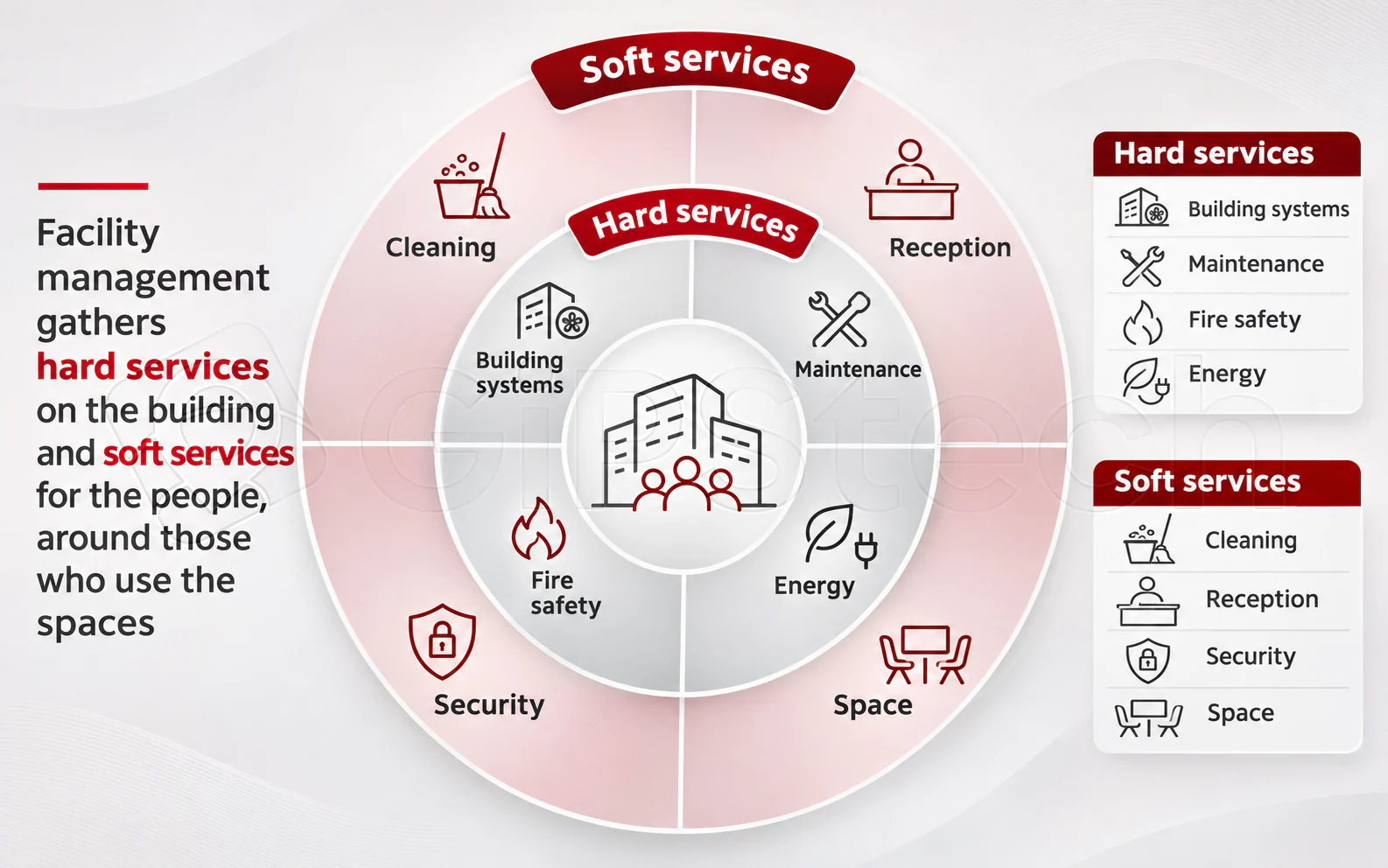
A service can cross both areas. Preparing a meeting room requires available space, comfort, cleaning and accessibility. Coordination must therefore remain clearly assigned even when several teams deliver the work. Asset management provides a complementary perspective on the physical resources that make those services possible.
Client, manager and delivery team
Section titled “Client, manager and delivery team”The client expresses the need and approves the service level. The manager organizes resources and priorities; the delivery team performs the work. One organization may hold several roles, but distinguishing them prevents requesting, execution and acceptance from becoming implicit responsibilities.
In-house delivery maintains a direct relationship with skills and resources; it still requires planning. Outsourcing requires clear boundaries, access arrangements and supplier checks. Contracting out work does not remove the client’s task of defining the outcome and checking its consistency with the organization’s needs.
An example in an imaginary building
Section titled “An example in an imaginary building”Aurora office centre prepares an area for an evening course. The space manager communicates dates and expected attendance; maintenance checks building systems; cleaning adjusts its schedule to the new occupancy. Reception receives the information needed to welcome visitors.
A final check finds a room unready. The record should distinguish work that was not performed from a requirement changed after planning. Updating the programme, informing the parties and checking restoration helps prevent the same problem from being treated repeatedly as an isolated event. A useful record explains both the outcome and the context in which it was assessed.
Useful information and limits
Section titled “Useful information and limits”An operational foundation includes identified spaces and equipment, included services, frequencies, assignments, outcomes and anomalies. Data must refer to the same scope: an intervention count does not describe whether spaces are usable. A service level defines what to measure; an indicator helps observe trends and causes.
A useful starting point is one bounded service and a verifiable question, such as why an area is not ready at the agreed time. A highly detailed database with no responsibility for updates can create more uncertainty than a small, reliable register. Technology and organization should be assessed together, including how teams receive changing requirements and report exceptions.
Standards as an organizational reference
Section titled “Standards as an organizational reference”UNI EN ISO 41011:2024 (opens in a new tab), listed as current in the UNI catalogue, provides sector vocabulary. ISO 41001:2018 (opens in a new tab), with Amendment 1:2024 (opens in a new tab), concerns requirements for a facility management system. At the November 2026 check ISO lists a revision under development: a draft does not constitute a newly published edition.
Adopting a standard is separate from purchasing software and from any certification process. Adoption is voluntary unless applicable requirements or contractual commitments need to be considered in a particular case. For further reading see cleaning and quality checks, buildings and public spaces, and GiPStech’s Asset2Work overview (opens in a new tab).