


 Italiano
Asset tracking connects an item’s identity with information about its location over time. An RTLS, or Real-Time Locating System, produces updates that can support ongoing work; this does not mean continuous, instantaneous or permanently available positioning. The first decision is whether movement must be followed or whether the last reliable information is enough to find equipment.
Three different kinds of information
Section titled “Three different kinds of information”- Real time: updates arrive at a frequency and delay suitable for the decision. There is still a latest observation, and interruptions may occur.
- Last known position: the location or coordinates of the most recent observation. Read these alongside its time, origin and the system’s coverage.
- Declared position: an association recorded by a person or a process, for example after a handover. It is useful when people moving the item keep the record current.
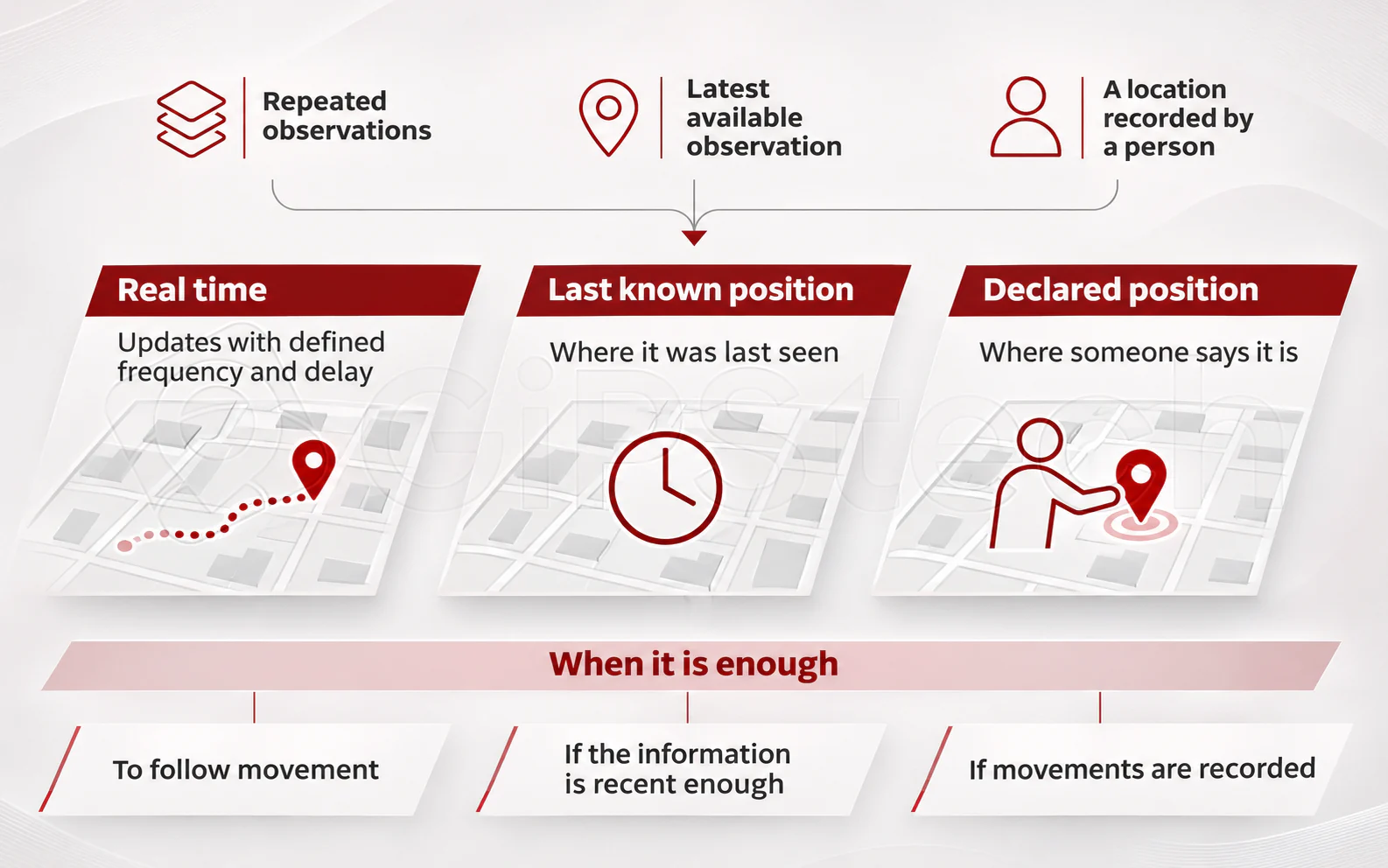
An old position can help a search but does not establish that the item is still there. Apparently precise coordinates do not compensate for slow updates. Building, floor, zone and point are also different levels of detail: each addresses a different need.
What makes up a system
Section titled “What makes up a system”The item must be recognizable: asset identification connects a code, label or tag with the register. Observations, devices that collect them and a spatial reference are then needed. The platform associates observations with the item and makes them interpretable in the site’s context.
An active tag has its own power source; a passive tag receives energy from the reader’s field. The RFID (opens in a new tab) family includes different solutions: reading a tag at a gate may record a passage without providing a position between gates. A phone may instead take part in locating its carrier, with different privacy implications.
Selection includes battery life, battery replacement, fixing, environmental resistance, readers and connectivity. An available communications network is not equivalent to a positioning infrastructure ready for use.
An example: how recent must the information be?
Section titled “An example: how recent must the information be?”An imaginary department needs a mobile pump before an inspection. Knowing that it was delivered to the correct room may be enough if movements are recorded. If it is shared across departments during a shift, more frequent observations may be needed. In both cases, staff still need to establish that they have found the correct item in the condition required for use.
This illustrates the economic criterion: compare the effort of searching and updating records with the effort needed for tags, infrastructure and maintenance. No update interval is cost-effective for every item.
Assessing performance and cost
Section titled “Assessing performance and cost”A trial should include representative routes, materials, floors, asset density and coverage gaps. Define beforehand which zone errors or delays make the information unusable; measure missed observations and the time needed to find an item as well. The technology comparison helps frame these questions.
ISO/IEC 24730-1:2014 (opens in a new tab), confirmed in 2025, concerns the application interface of RTLS systems. ISO/IEC 18305:2016 (opens in a new tab) concerns localization and tracking metrics and tests: as checked in November 2026, it is published, with a revision under preparation. Neither promises accuracy for a particular installation.
The connection with Asset2Work
Section titled “The connection with Asset2Work”Asset2Work associates assets with locations and retains position information according to the adopted model and tracking system. A location assignment and an automatic observation have different origins: the suite does not make every item automatically traceable in real time.
The GiPStech page on asset location and tracking (opens in a new tab) introduces project scope. The operational model is in the reserved documentation on assets and locations, which requires access. The healthcare example develops the equipment-search scenario.