


 Italiano
In a factory, downtime costs more than the maintenance technician’s hours: it can interrupt a production sequence, leave people waiting and require a controlled restart. Searching for a trolley or tool can also delay work even when no machine has failed. Improvement requires distinguishing the causes and connecting production, maintenance and intralogistics.
Understand losses before choosing a solution
Section titled “Understand losses before choosing a solution”OEE, Overall Equipment Effectiveness (opens in a new tab), considers availability, performance and quality together. A plant may run throughout a shift while producing slowly or generating rejects: the result does not depend on maintenance alone. Research on manufacturing KPIs with NIST authors (opens in a new tab) explains why indicators need to be read as a system of relationships, using consistent definitions and data.
TPM, Total Productive Maintenance (opens in a new tab), involves different company functions in improving equipment and people’s performance. The Japan Institute of Plant Maintenance (opens in a new tab), which proposed the method, emphasizes organization-wide involvement. This does not mean assigning specialist interventions to anyone: tasks, training and safe working conditions need to be defined.
Before comparing departments or shifts, agree what counts as downtime, how waits are classified and which periods enter the calculation. Maintenance KPIs help avoid conclusions based on a single number.
Coordinate plans, spare parts and maintenance windows
Section titled “Coordinate plans, spare parts and maintenance windows”Criticality does not necessarily match the machine’s price. An inexpensive component with no alternative can stop a line; a costly asset with redundancy may allow more planning flexibility. Priorities need to consider consequences, substitution options, procurement lead times and working conditions.
A plan needs to coordinate skills, plant availability and spare parts. A history of causes and outcomes helps review intervals and distinguish recurring failures from isolated events. Product operations are covered by the reserved warehouse management documentation, which requires sign-in; it is not needed to understand these principles.
Make equipment and materials findable
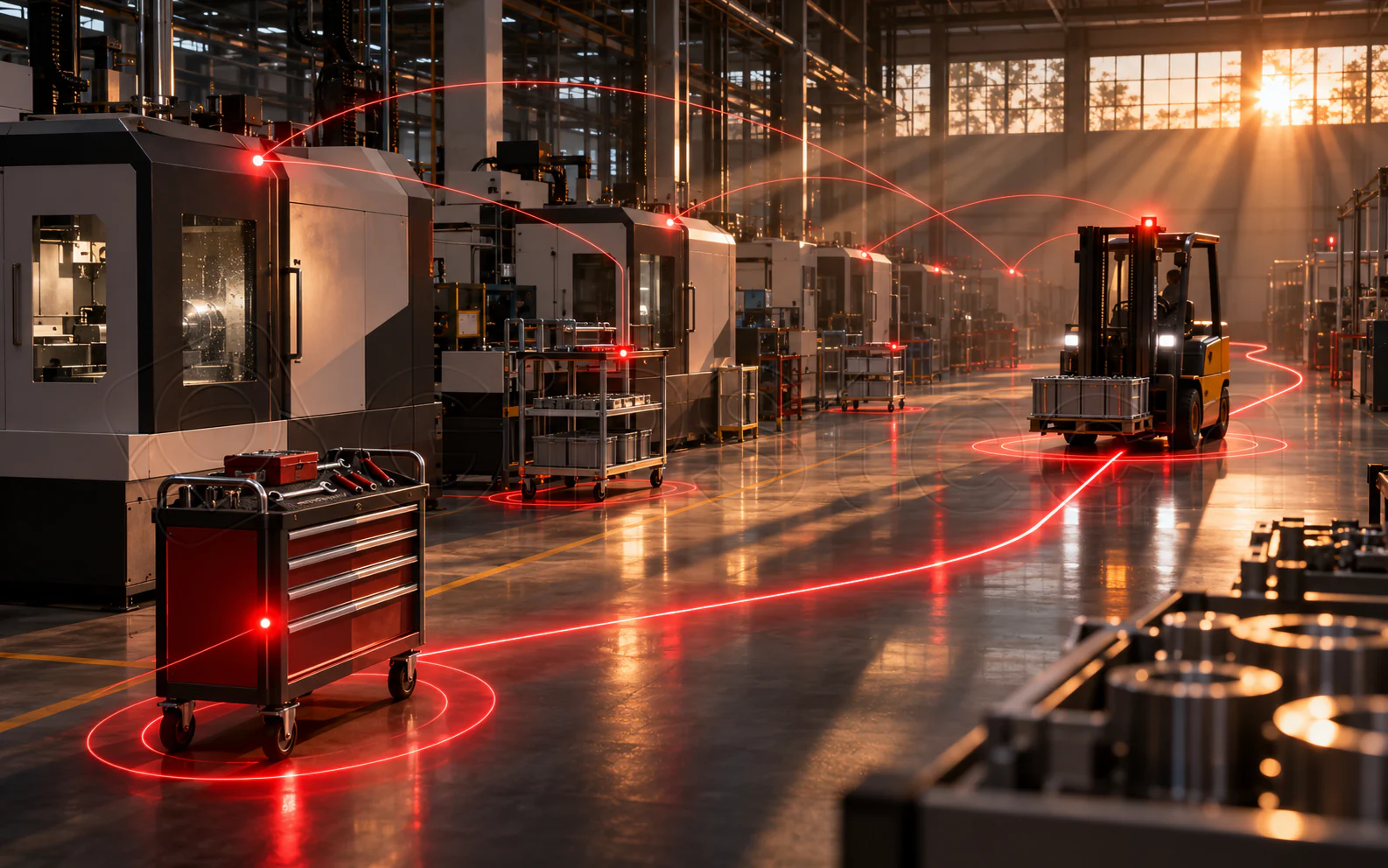
Section titled “Make equipment and materials findable”Asset tracking also concerns trolleys, reusable containers and shared tools. The useful requirement may be knowing which zone contains an item, rather than reconstructing every centimetre of its route. Coverage, accuracy and update frequency should answer the operational decision.
In Asset2Work, an asset can have a location reference and a plan can generate activities associated with it. Location alone does not establish material availability or completed maintenance. GiPStech’s manufacturing solutions (opens in a new tab) present the connection between localization and processes: integrations require identifiers, responsibilities and checks agreed within the project.
A packaging line example
Section titled “A packaging line example”In a fictional factory, a line frequently stops while staff search for a trolley containing suitable tools. The group distinguishes search time from technical failure and from waiting for authorization. It then organizes recognizable tool storage and a plan for recurring machine activities.
The before-and-after comparison considers downtime causes, search time and the completeness of recorded work. An OEE improvement is not automatically attributed to the software: layout, training or material quality may have contributed. Predictive maintenance is a possible separate development, requiring condition data and validated models; it is not an automatic consequence of digitization.
Safety and project limits
Section titled “Safety and project limits”In the Italian framework, Legislative Decree 81/2008 (opens in a new tab) also concerns the safe use of work equipment. For machinery, distinguish product rules from management of its use: the European Commission (opens in a new tab) gives 20 January 2027 as the general application date of Regulation (EU) 2023/1230, in the transition from Directive 2006/42/EC. Entry into force and general application are different dates.
This educational article uses European and Italian examples and does not replace legal or regulatory advice. Check official texts, transitional provisions and applicable requirements. Tracking and digital plans do not replace guards, authorizations or safe working procedures.