


 Italiano
Introducing an operations management platform should start from one priority process, with identifiable people, data and outcome criteria. Digitalizing everything at once makes it harder to understand where errors arise and which benefits have been achieved. Even a limited initial scope should cover the work from its beginning through review of the outcome.
The Asset2Work deployment approach (opens in a new tab) follows this logic: process definition, data preparation, user involvement, training and expansion based on feedback. The stages below are project criteria, rather than an application procedure.
Select the first process
Section titled “Select the first process”A good starting point is a frequent activity representative enough to test the way work is done: for example, periodic inspections of one equipment family. Define the current problem, the items involved, who decides and who carries out the work, and which evidence will allow the outcome to be assessed.
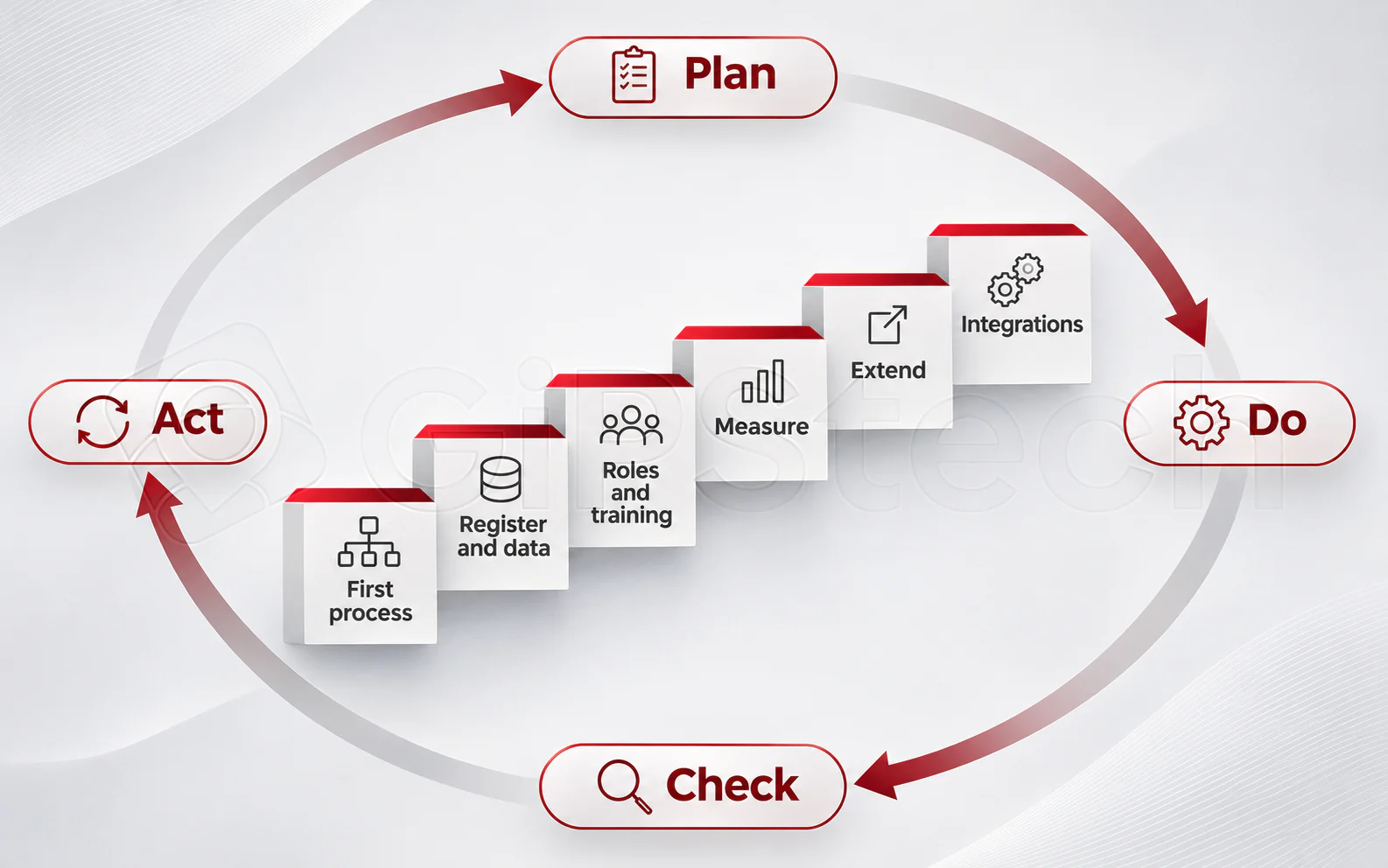
An objective such as “reconstruct every inspection in the selected family from item to outcome” is more useful than a generic “remove paper”. The former reveals missing data and uncovered handovers. A process that is too exceptional, however, may not represent everyday work.
Prepare records, roles and training
Section titled “Prepare records, roles and training”The initial register should provide the data the process needs: item identity, an understandable description, location and useful references. Collecting every possible detail is unnecessary if nobody can keep it current. Duplicates and ambiguous names should be resolved before they become references for work.
Responsibilities establish who prepares assignments, documents work, reviews outcomes and corrects data. Training should use a complete case and include exceptions: an item not found, an impossible check, an anomalous outcome or a lack of connectivity.
For Asset2Work, plans and checklists should reflect the checks actually required. Participants need to try the process with the intended devices and permissions, without assuming a successful office demonstration covers every field condition.
Measure before expanding
Section titled “Measure before expanding”Before launch, decide how to observe the initial situation. Useful questions include how many interventions can be reconstructed, which data are missing, and how much effort collecting reports requires. After initial use, apply the same criteria to the same scope with consistent definitions.
This approach reflects the PDCA cycle (opens in a new tab): plan, do, check, act. Define an expected outcome, try the process, examine the evidence and correct what does not work. A perfect measurement is unnecessary to recognize a problem, but improvements not demonstrated by the data should not be attributed to the software.
ISO 55001:2024 (opens in a new tab) addresses requirements for an asset management system. It provides an organizational reference broader than adopting a tool: installing a platform does not establish compliance with its requirements or grant certification. Asset management and the ISO 55000 series explains the relationship between tools and the management system.
Expand and design data exchanges
Section titled “Expand and design data exchanges”Expansion to other items or sites requires a fresh assessment of people, data and operating conditions. The initial model is a basis for adaptation, rather than automatic copying. Where localization is included, assess coverage, infrastructure and the meaning of a position useful to the process.
Integrations begin by establishing which data to exchange, which system owns them and how errors will be handled. They can follow consolidation of the first process; if essential to its operation, they are instead a prerequisite. They should not be treated as ready-made connections to any application.
A fictional example
Section titled “A fictional example”Aurora starts with inspections of a single equipment family. Before expanding, it checks that items are recognizable, technicians and managers can reconstruct outcomes, and exceptions have a clear recipient. Only then does it decide which other activities to introduce. What Asset2Work is helps place this first process within the platform’s broader capabilities.