


 Italiano
CMMS, EAM and CAFM describe three perspectives on management software: maintenance, assets throughout their lives, and buildings and services. Their scopes overlap and the acronyms do not guarantee identical feature sets. Selection requires comparing the processes, information and responsibilities the system must support.
Three starting points
Section titled “Three starting points”A CMMS, Computerized Maintenance Management System, focuses on maintenance work: requests, planning, interventions and asset history. A workflow model published by NIST (opens in a new tab) describes the connection between work orders, documentation and resource information, noting that actual implementations can differ.
EAM, Enterprise Asset Management, extends the perspective of asset management to decisions about the asset portfolio and its lifecycle. The aim is to connect use, maintenance, investment and replacement. Actual breadth depends on the product and integrations: the acronym does not mean that every financial or engineering function is included.
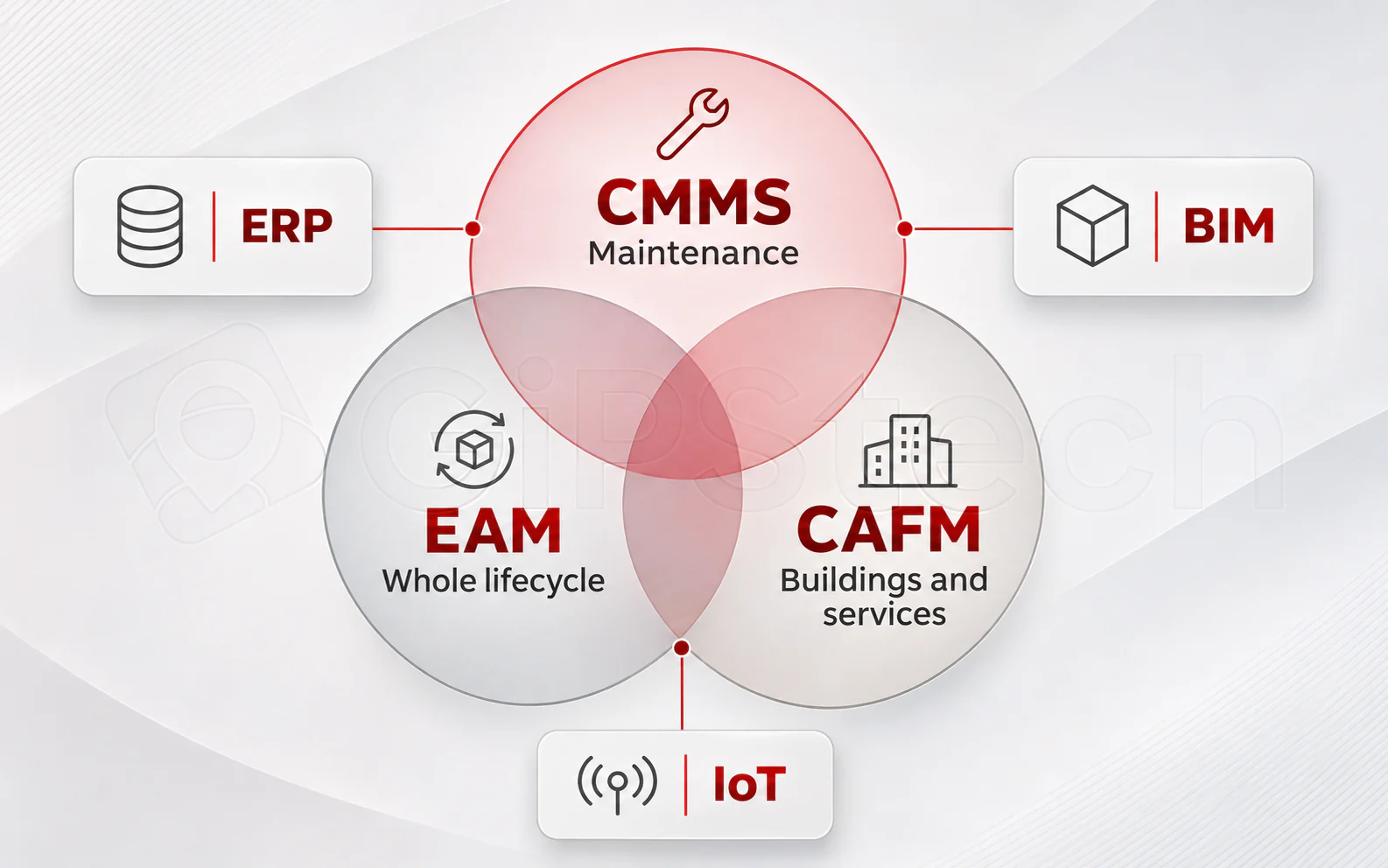
CAFM, Computer-Aided Facility Management, starts with buildings, spaces and the services that enable their use. It can address both plant maintenance and the organization of environments. The perspective of facility management in ISO 41001 (opens in a new tab) concerns the management system; the standard does not specify mandatory features for CAFM software.
Where the scopes overlap
Section titled “Where the scopes overlap”A repair request for an air-conditioning system can involve all three perspectives: work to assign, an asset whose history matters, and a building that must remain usable. The same information should not be re-entered without control in three separate stores.
Define which system governs each piece of information: asset identity, location, request status or actual cost. Other systems can receive a copy or reference under explicit updating rules. The problem to solve is information continuity, not the number of acronyms adopted.
ERP, BIM and IoT around the system
Section titled “ERP, BIM and IoT around the system”The ERP (opens in a new tab) may be the reference for purchasing and accounting. BIM (opens in a new tab) provides an information context for buildings and components. The IoT (opens in a new tab) may supply device measurements. These are possible data sources or destinations, not integrations to assume are already available.
An exchange requires agreement on identifiers, field meanings, frequency, responsibilities and errors. A sensor alarm, for example, does not automatically mean a confirmed failure or an authorized maintenance intervention. Someone must decide who assesses it and how that assessment is recorded.
An example selection
Section titled “An example selection”An imaginary organization manages two buildings with laboratories. Its first problem is lost repair requests and poor visibility of upcoming inspections: maintenance is the starting process. If it also needs to compare asset renewal and use across sites, the EAM perspective matters. If space use and building services are the priority, CAFM requirements gain weight.
The three needs can coexist. Testing a complete scenario with representative data, from a request to its outcome, and checking how history can be exported is useful. A demonstration of individual features does not prove process continuity.
Assessment criteria and limits
Section titled “Assessment criteria and limits”- Processes: which decisions and activities should improve, with what observable outcomes?
- Information: register quality, available documents and responsibility for updates.
- People: roles, training and field working conditions.
- Exchanges: connected systems, data ownership and error handling.
- Total effort: rollout, configuration, devices, support and integration maintenance.
ISO 41001:2018 (opens in a new tab), with Amendment 1:2024 (opens in a new tab), remains published at the November 2026 check while a revision is under development. Software does not replace the organizational management system or constitute certification in itself.
Where Asset2Work fits
Section titled “Where Asset2Work fits”Asset2Work connects asset records and operational activities, including plans and checklists within the maintenance scope. This positioning does not imply coverage of every function associated with EAM or CAFM: scope must be defined around the required processes.
For orientation see What Asset2Work is and GiPStech’s CMMS maintenance page (opens in a new tab). The facility management article provides further domain reading.