


 Italiano
The asset lifecycle connects initial decisions with use, changes and disposal. Following it means retaining the information needed at each handover and assigning clear responsibilities. Maintenance is one part of the journey: the quality of decisions also depends on what happens before installation and after the asset leaves service.
Before acquisition: define the need
Section titled “Before acquisition: define the need”The perspective of ISO 55000:2024 (opens in a new tab) helps consider the asset throughout its life. Before buying it, clarify the required function, operating context and consequences of unavailability. Repairing, sharing or renting an existing item may meet the need.
The example below groups the journey into five phases for clarity. This is not a mandatory sequence defined by the standard: transfers and maintenance may recur, while an asset may remain in one phase for a long time.
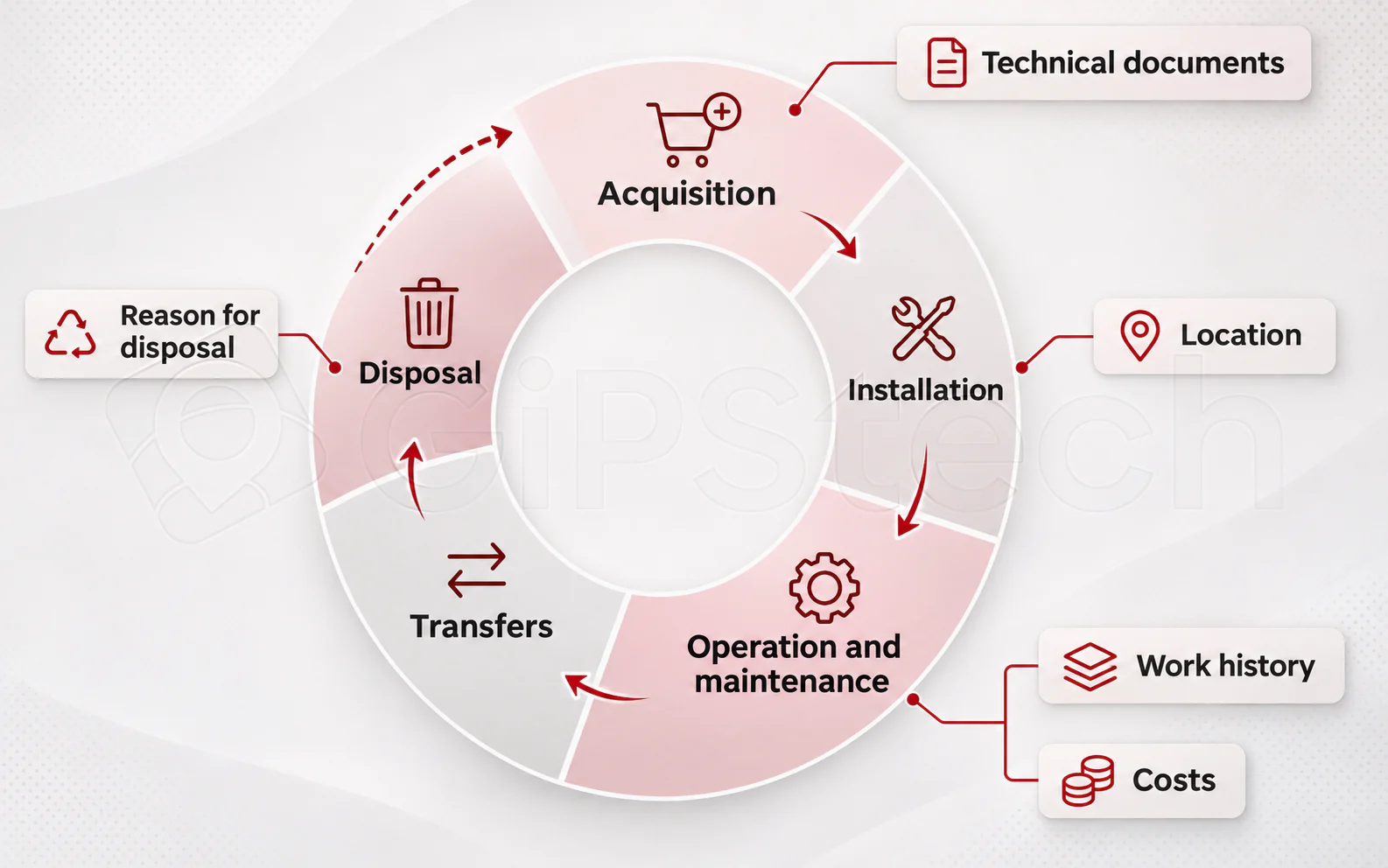
The segment returning from disposal to acquisition represents possible replacement: a new asset begins its life with its own identity, while the previous item’s history is retained.
Five phases and the information to retain
Section titled “Five phases and the information to retain”Acquisition. Purchasing collects specifications, supplier references, support conditions and available documentation. Users and maintainers help assess access, spare parts and required skills. A low initial price may be accompanied by substantial operational effort.
Installation and commissioning. Link documentation to the individual item, confirm its location and responsible party, and record the results of checks required in that context. UNI EN 13460:2009 (opens in a new tab), currently in force, distinguishes technical documentation useful before commissioning from maintenance information produced during operation.
Operation and maintenance. Use, failures, inspections, maintenance and the resources consumed build the asset’s history. A failed check and an unresolved issue are different information from completed work. Strategy depends on function and risk: types of maintenance explores the alternatives.
Transfers. Movement requires updating location, availability and responsibility while keeping the same identity. Operating conditions and inspection plans may change too. “Delivered” should be distinguishable from a merely planned destination.
Disposal. Leaving service requires a documented decision: reason, date and destination of the asset, together with obligations relevant to the case. Its history remains useful for comparing repairs and replacements. New equipment receives its own identity: linking it to the replaced item must not merge their events.
An example: a pump changes use
Section titled “An example: a pump changes use”An imaginary laboratory acquires P-017 for a cooling circuit. During installation, it associates the manual and initial checks. Over the years, maintenance and downtime are recorded. The pump is later transferred to a less demanding duty and the register reflects the new location without losing its earlier history.
When the next repair appears poor value relative to service needs, replacement is considered. The reason for the decision remains associated with P-017; the new item has a separate record. The comparison concerns the actual need, not just the age of the equipment.
Total cost and responsibility handovers
Section titled “Total cost and responsibility handovers”Total cost of ownership considers the selected analysis horizon: acquisition, installation, consumption, maintenance and end of life, with any residual value. The comparison may also consider the economic consequences of downtime, making assumptions explicit. It is neither a universal formula nor an automatic accounting valuation.
Information needs an owner: purchasing for initial documents, technicians for commissioning, operators and maintainers for events, and asset managers for transfers and disposal. In a small organization, one person may cover several roles; knowing who updates what and when remains useful.
Benefits and limits of the approach
Section titled “Benefits and limits of the approach”A continuous history helps assess alternatives and prepare handovers. It requires a consistent register, stable identifiers and up-to-date documents. Missing information must be acknowledged: a record with no logged failures does not demonstrate that no failures occurred.
A declared location does not prove where the asset is now. Where that information is needed, asset tracking is a separate subject with its own requirements and limits.
Further reading
Section titled “Further reading”For the decision-making framework, see Asset management and ISO 55000. GiPStech’s asset management page (opens in a new tab) introduces the application context. The standards cited provide general references: documentation requirements must be defined for the particular technical and regulatory context.