


 Italiano
Planning activities means deciding what must be done, with which resources and priorities. Scheduling places that work in time and assigns it to available people. These decisions are connected: a full calendar does not demonstrate a sustainable workload or the availability of every necessary skill.
From the need to the recurrence
Section titled “From the need to the recurrence”Start with the required outcome: inspect equipment, perform cleaning or transfer an asset. Frequency follows the process, relevant instructions and applicable constraints; it should not be chosen simply because it is convenient to display in a calendar.
A monthly activity anchored to a fixed date is different from one repeated after an interval from the last execution. When work is late, the first approach can shorten the gap between two executions, whereas the second can move the following due date. The criterion needs an explicit decision, without turning every delay into an automatic extension.
UNI EN 17007:2018 (opens in a new tab), current at the November 2026 check, describes maintenance processes and their relationships in general terms. It provides a reference for organizing responsibilities and information, rather than prescribing frequencies for every asset.
Skills, teams and capacity
Section titled “Skills, teams and capacity”The bars show example qualitative workloads, without calculated values or percentages; the skill symbols do not represent specific professional qualifications.
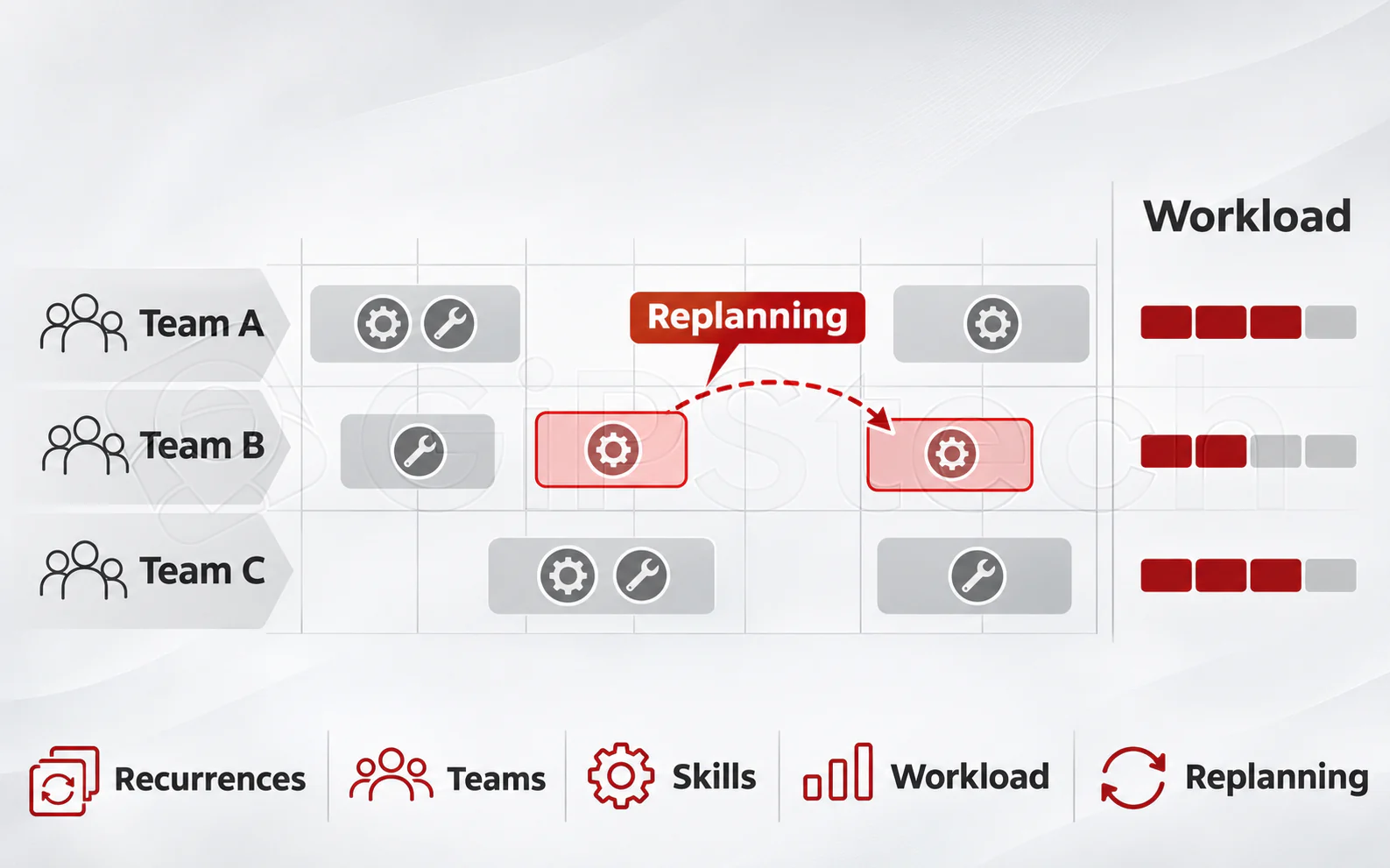
Assigning work requires expected duration, skills, equipment, materials and access conditions. A team may bring together people with complementary capabilities; a service line may represent a stable organizational scope. These groupings clarify responsibility but do not demonstrate that every member is qualified for every task.
Workload extends beyond technical execution time. Travel, preparation, documentation, breaks and unexpected events need consideration too. Having two people available for one hour does not automatically make a task requiring two uninterrupted hours of a particular skill feasible.
An example of distributing work
Section titled “An example of distributing work”At the imaginary Aurora centre, team A performs mechanical inspections, team B electrical checks and team C equipment transfers. A visit includes an inspection and a transfer: the two activities can be coordinated while retaining different skills and outcomes.
The planner groups work by area where this reduces travel without compromising due dates or safety conditions. Before confirming the week, availability, room access and materials are checked. The illustrated calendar is an example of reasoning, rather than a promise of automatically optimized assignment.
Replanning while retaining the reason
Section titled “Replanning while retaining the reason”Absence, an urgent failure or unavailable equipment may require a change. Moving an assignment is different from changing the recurrence rule: solving this week’s problem does not imply changing every future activity.
The decision should retain the reason, new responsibility and consequences for deadlines. Work not carried out does not become completed because it has moved. If a constraint cannot be met, the issue needs to reach someone who can assess the risk and authorize the necessary action.
Assessing planning quality
Section titled “Assessing planning quality”Comparisons between expected and recorded duration, postponed work, urgent requests and travel time can be useful. Read figures over the same scope: more postponements may result from incomplete data or changed priorities, as well as insufficient resources.
Reliable planning requires current information and discussion with the people doing the work. For maintenance, the maintenance plan organizes the content from which assignments are derived. The same reasoning can support other services, each with its own requirements.
Further reading
Section titled “Further reading”GiPStech’s operational workflows and missions page (opens in a new tab) provides the application context. Operations for Task plans and tasks and Service resources are in the reserved documentation and require sign-in.