


 Italiano
A maintenance plan connects the assets to be maintained with necessary activities, execution criteria and resources. It answers “what needs doing, and why?”. Scheduling then turns these choices into assignments and dates: a list of due dates alone does not make a plan complete without appropriate technical content.
Start with the inventory and criticality
Section titled “Start with the inventory and criticality”The plan requires a sufficiently reliable asset register: identity, purpose, location and relevant documentation. Criticality helps distinguish the consequences of unavailability. Similar assets may need different priorities when one supports an essential service while the other has a spare. A high, medium and low qualitative scale is one possible aid, provided the categories have defined criteria.
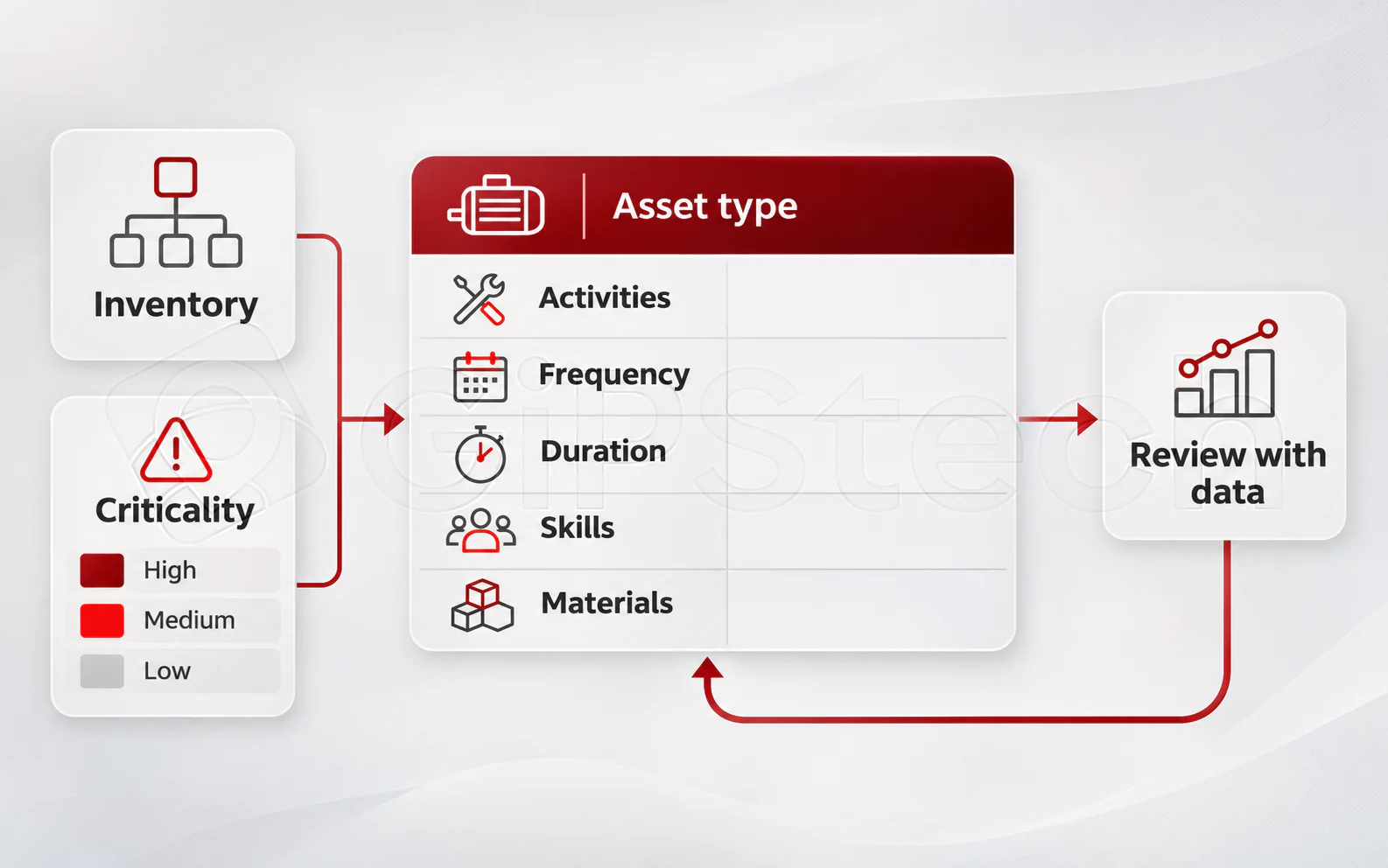
The assessment considers manufacturer instructions, operating experience, environmental conditions and applicable obligations. There is no universal frequency for an equipment family regardless of use. An initial template helps only when someone checks that it matches the actual assets.
The content of each activity
Section titled “The content of each activity”For each type of inspection, clarify:
- Activity and outcome: what to check and which evidence to retain.
- Frequency or trigger: calendar, usage or condition that calls for the work.
- Duration: technical estimate and time needed for preparation and restoration.
- Skills: who can execute and who must assess the outcome.
- Materials and equipment: parts, tools, access and availability requirements.
Acceptance criteria and a response to anomalous outcomes are also needed. “Check the pump” is too vague if the technician does not know what to observe, which method to use and who should receive an issue. Technical instructions must be prepared by people competent for that equipment.
Documentation and references
Section titled “Documentation and references”UNI EN 17007:2018 (opens in a new tab) provides a general maintenance process framework. UNI EN 13460:2009 (opens in a new tab) concerns documentation useful before commissioning and during operation. For buildings, UNI EN 15331:2011 (opens in a new tab) addresses planning, management and control criteria and methods. All three are current at the November 2026 check; this introduction explains their scope without reproducing their requirements.
The plan version, referenced documents and approval responsibilities should be recognizable. A superseded manual or a plant modification may make an inspection unsuitable even while the calendar continues generating due dates.
An example of a proportionate plan
Section titled “An example of a proportionate plan”At the imaginary Aurora laboratory, a family of pumps serves an auxiliary circuit. The plan identifies each unit, distinguishes the spare and gathers the relevant inspections from available instructions. For each activity it specifies skills, materials and recording arrangements, without inventing limits or intervals.
The table shows how to connect this information for an inspection of the pump identified as P-01. It is an educational outline to complete using the equipment documentation, not a technical plan ready for use.
| Plan item | Example for P-01 |
|---|---|
| Asset and function | Auxiliary circuit pump; identify whether it is in service or a spare. |
| Inspection and criteria | Reference the instruction and revision defining the method, quantities to observe and acceptance criteria. |
| Frequency or trigger | State the required time or usage interval and the reference that justifies it. |
| Resources | Identify required skills, estimated duration, materials and access conditions. |
| Evidence and anomalies | Record the date, performer and outcome; identify who assesses anomalies and decides subsequent actions. |
The manager then compares workload with resources and agrees the activity schedule. A checklist turns the checks to be documented into readable questions while retaining a connection to the applicable instruction revision. The plan describes the agreed approach; each completed job provides information about what actually happened to a particular item.
Review the plan using data
Section titled “Review the plan using data”Repeated failures, checks that cannot be performed, durations far from estimates or changes in use are reasons to revisit the plan. Review should distinguish a defective rule from an occasional execution problem.
Maintenance KPIs help interpret these signals: failures, repair times, remaining work and deadline compliance need to be compared over the same scope and period.
Reducing a frequency because people are unavailable does not demonstrate that the risk is acceptable. Equally, adding inspections without assessing their usefulness can increase workload without improving decisions. Periodic review should justify changes, retain assumptions and examine their effects.
Further reading
Section titled “Further reading”The preventive maintenance article introduces the strategies; GiPStech describes the CMMS maintenance context (opens in a new tab). Operations for Task Plans are in the reserved documentation and require sign-in. This standards overview is educational: technical decisions require applicable official texts and relevant expertise.