


 Italiano
A request reports a need; a work order defines the work, responsibility and necessary information. Distinguishing them prevents every report from automatically becoming an assignment and avoids confusing administrative closure with restoration of an asset’s function.
From the report to a decision
Section titled “From the report to a decision”A useful request describes the observed problem, asset or location involved, time of observation and visible consequences. The requester need not invent a technical diagnosis: “the pump stops during use” is different information from confidently attributing the failure to a particular component.
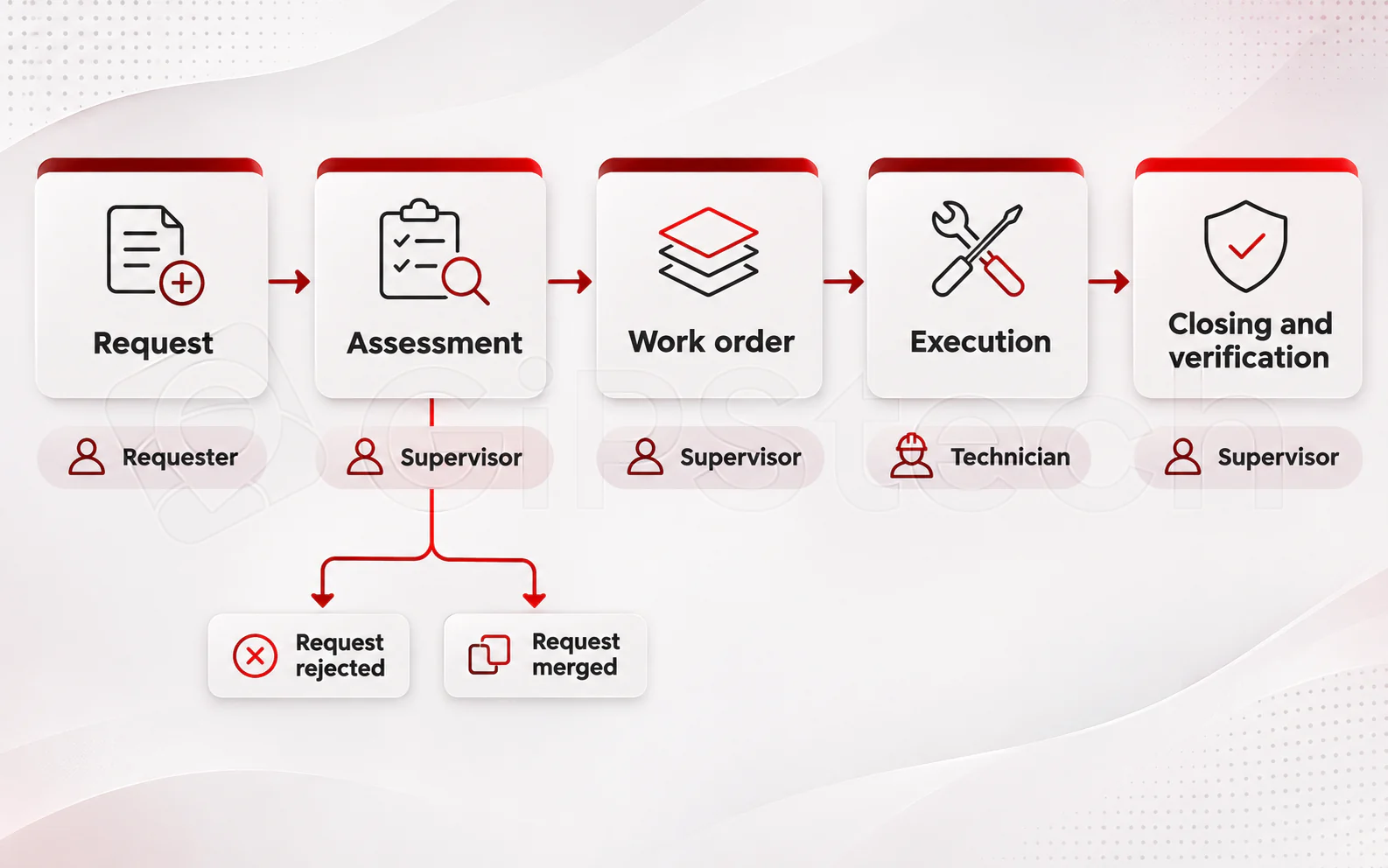
The assessor checks whether the issue is already known, whether information is missing, whether work is needed and which priority applies. A request may be rejected with a reason, merged into an existing case or turned into work. Retaining the connection helps explain to the requester how their contribution was handled.
UNI EN 13306:2018 (opens in a new tab) provides maintenance terminology; UNI EN 17007:2018 (opens in a new tab) describes the processes in general terms. Both are current in November 2026. The path presented here is an organizational example, rather than a set of statuses prescribed by the standards or an application.
The order makes the work explicit
Section titled “The order makes the work explicit”A work order should connect the subject, activity description, responsible party, priority and completion criteria. It may refer to instructions, materials, skills and access conditions. Assignment does not demonstrate that work has started, just as a planned date is different from the actual intervention date.
Responsibilities fit the organization: the requester reports; a supervisor assesses and coordinates; the technician executes and documents. In a small team one person may hold several responsibilities, but the stages retain different meanings. A clear handover includes enough context for the next participant without asking them to reconstruct earlier conversations.
Execution and exceptions
Section titled “Execution and exceptions”During the job, record what was actually done, the outcomes and any issues still open. Work interrupted because a spare part is missing is different from work completed with a positive result.
The process needs to define who receives clarification requests, who authorizes changes and how an impediment is communicated. Minimum information depends on the work, but the reason, responsibility and next step should remain recognizable. An urgent situation may require a direct communication channel as well as a digital record.
Closure and verification are different decisions
Section titled “Closure and verification are different decisions”The executor may declare work finished and attach outcomes; the reviewer assesses whether the evidence meets the required criteria and whether further action is needed. Administrative closure alone does not demonstrate that every risk has been removed or that the asset can return to service.
If new information emerges, the organization may provide for reopening or a new linked assignment. Either choice should retain a readable history: changing the original outcome retrospectively without explanation makes events harder to reconstruct.
An example and the times to measure
Section titled “An example and the times to measure”At the imaginary Aurora laboratory, an operator reports that P-017 is leaking. The supervisor checks that the report is not a duplicate and assigns investigation to a competent person. The technician documents the intervention and a subsequent check; the supervisor assesses the results and decides what follows.
Measuring service requires distinguishing receipt, acceptance, start, restoration and closure. Service levels need agreed starting events, calendars and calculation rules. The number of closed cases alone describes neither work quality nor the full set of outstanding requests.
Further reading
Section titled “Further reading”See Corrective maintenance, Checklists and traceability and GiPStech’s operational workflows page (opens in a new tab). Product operations are covered in Tickets, reserved documentation, which requires sign-in.