


 Italiano
Asset2Work can involve service managers, planners, technicians, suppliers and organization administrators. To understand who should use it, distinguish who decides, who plans, who carries out the work and who checks it, before discussing access. These are work responsibilities, rather than four compulsory profiles to reproduce in every organization.
The Asset2Work overview (opens in a new tab) presents a platform connecting assets and activities. For that connection to be useful, each handover needs a recognizable owner and enough information for the next participant.
Four responsibilities to make explicit
Section titled “Four responsibilities to make explicit”Who decides sets objectives and priorities: which items are critical, what outcome is expected from the service and which resources to make available. A manager can use collected information to assess work; the system does not select objectives or budgets on their behalf.
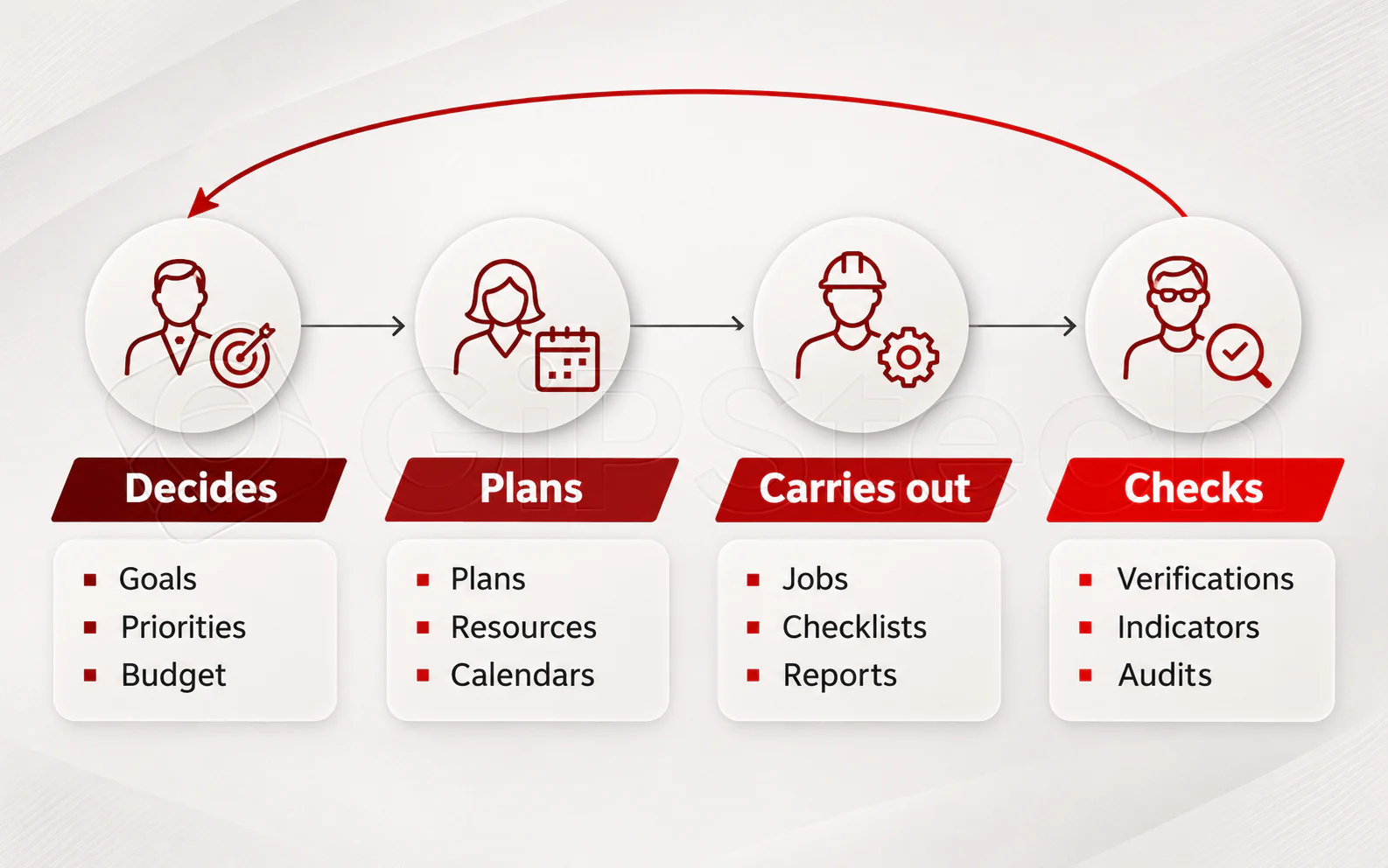
Who plans translates objectives into activities and assignments. This requires knowledge of the items involved, required checks, deadlines, skills and people’s availability. In Asset2Work, plans and assignments connect these elements to the operational process; a sustainable schedule still requires discussion with those carrying out the work.
Who carries out the work performs activities and documents observations. Technicians must distinguish the requested activity from the actual outcome, including anything they could not complete. The app supports checklists and outcomes in enabled processes; an authorized phone does not grant permission for every action.
Who checks compares records with established criteria, investigates anomalies and feeds information back to decision makers. Review may concern one intervention or the performance of a service. A completed checklist is information to assess, rather than automatic certification of work quality.
In a small team, one person may hold several responsibilities. Where a process requires independent review, the organization must establish separation between execution and checking: platform use alone does not imply it.
Reporting, execution and administration are different tasks
Section titled “Reporting, execution and administration are different tasks”Someone encountering a fault can provide useful information without being the technician who will resolve it. Asset2Work handles reports linked to an asset or described as generic requests; the ability to create them depends on the access and permissions provided. It should therefore not be assumed that everyone with the app, or any visitor, can open a request.
An appointed supplier can participate as an executor or coordinator, with agreed responsibilities and visibility. Clarifying which data they need and who accepts the outcome is useful, especially when several organizations contribute to one service.
The organization administrator manages users and settings within their remit. This differs from directing the service: configuring access does not automatically make someone responsible for interventions. Matters requiring assistance are referred to GiPStech Support.
Permissions translate responsibilities into access
Section titled “Permissions translate responsibilities into access”Asset2Work distinguishes web and mobile access and applies permissions to operations. Available actions also depend on the activity and its state: being able to view an assignment does not imply permission to change or complete it.
A sound role definition starts with concrete questions: what information must this person read? Which data should they change? Which outcomes may they confirm? Operational rules are explained in Operators, devices and access, reserved documentation and Roles and permissions, reserved documentation; both require sign-in.
A fictional example
Section titled “A fictional example”At the Aurora centre, Elena sets inspection priorities, Marco organizes assignments, Sara carries out checks and Paolo reviews outcomes. An attendant reports an anomaly without thereby taking responsibility for the repair. If Sara cannot complete the work, that information needs to reach someone who can reorganize it.
The division also becomes clearer by distinguishing office work and field work. The principle is to give each participant relevant information and responsibilities, avoiding broader access solely for convenience.