


 Italiano
Here, asset management concerns physical assets such as plant and equipment. It connects decisions about assets to an organization’s objectives throughout their lives. It includes maintenance as well as investment, use, replacement and responsibilities. The ISO 55000 series (opens in a new tab) provides a framework for addressing these aspects together.
Value, risk, performance and costs
Section titled “Value, risk, performance and costs”The value of a physical asset depends on its contribution to a service. A pump may be valuable mainly because it keeps plant operating. The cheapest immediate option is not necessarily the most suitable over the asset’s whole life.
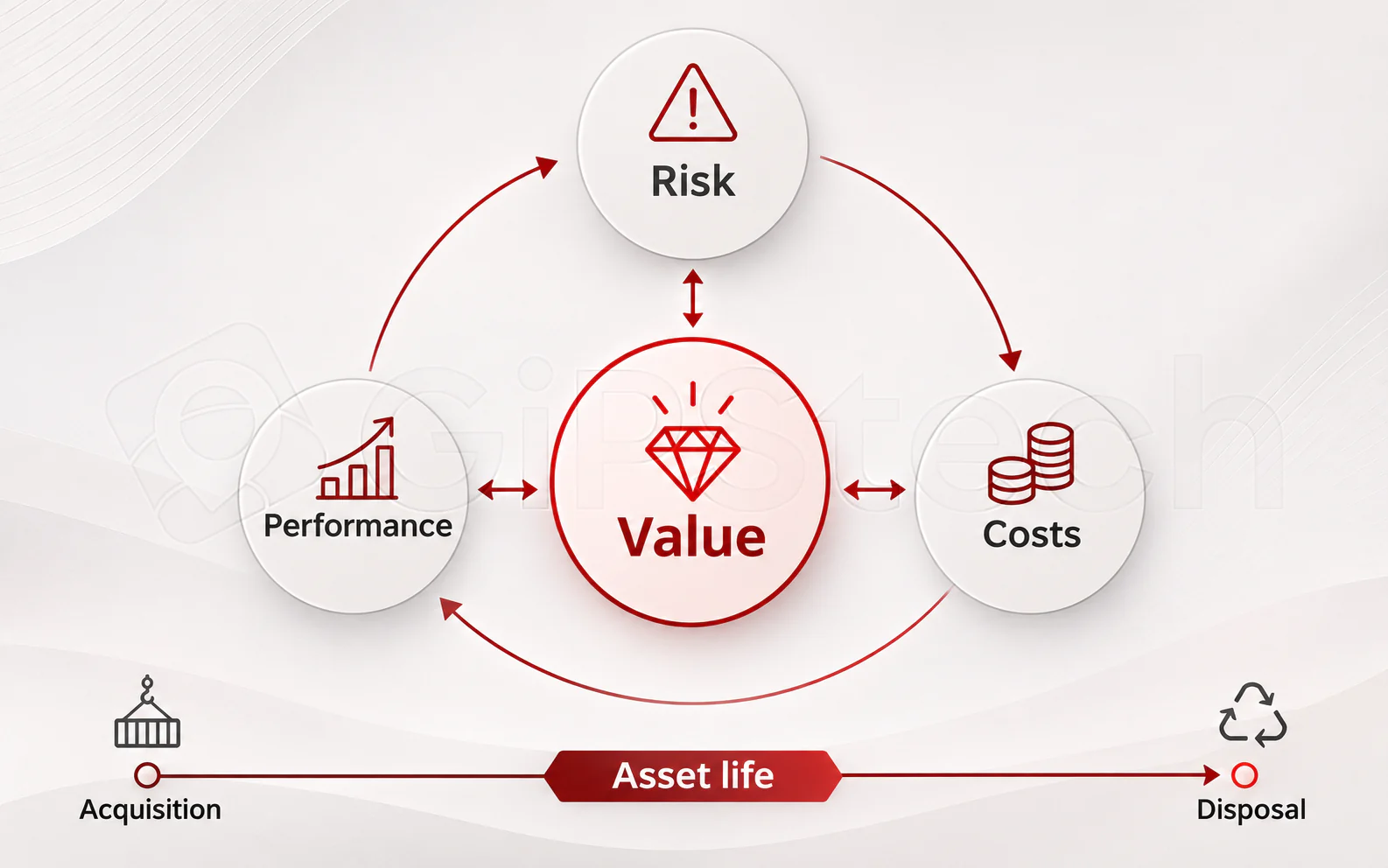
A decision brings together four questions: what outcome is needed, what performance is required, what consequences would failure have, and what resources are necessary? Risk concerns the likelihood and consequences of events; performance concerns how well the asset meets the need; costs also include operation, maintenance and end of life.
There is no single balance for every organization. The same equipment can have different priorities when it supports an essential function or has a ready spare. Explicit criteria, reliable information and responsibility for approving decisions are therefore needed.
What the standards in the series cover
Section titled “What the standards in the series cover”The official records consulted in November 2026 distinguish these published references:
| Standard | Scope |
|---|---|
| ISO 55000:2024 (opens in a new tab) | Vocabulary, overview and principles of asset management. |
| ISO 55001:2024 (opens in a new tab) | Requirements for an asset management system. |
| ISO 55002:2018 (opens in a new tab) | Guidance for applying ISO 55001; the catalogue also lists a revision under development. |
A management system includes organization, processes and decision rules. It is not synonymous with an information system. These standards concern how the organization governs its assets; they are not technical manuals for repairing every type of plant.
Edition dates do not always match. Before a standards project, check the relevant texts and revisions rather than treating a draft under development as a published standard.
Where maintenance fits
Section titled “Where maintenance fits”Maintenance helps retain or restore an asset’s required function. Its records inform wider decisions: repeated failures, scarce spare parts or downtime may justify reviewing how equipment is used or replacing it.
The maintenance plan translates asset decisions into activities, criteria and responsibilities. Its review uses intervention records and remains part of decisions across the lifecycle.
UNI EN 16646:2015 (opens in a new tab), currently in force, addresses maintenance within physical asset management. UNI EN 17485:2021 (opens in a new tab), also in force, concerns methods for incorporating maintenance into decisions about physical assets. They are complementary references, not alternative names for ISO 55001.
An example decision
Section titled “An example decision”An imaginary laboratory must decide whether to keep an old pump or replace it. The comparison considers the new machine’s price, expected maintenance, spare availability, energy use and the consequences of downtime. Age alone does not settle the decision.
When information is incomplete, a period of observation with defined criteria may help: record failures, downtime and maintenance, then revisit the decision. The asset lifecycle provides context for a comparison that extends beyond the initial price.
Software and certification have different roles
Section titled “Software and certification have different roles”Software can make registers, documents and decision data available. Competent people, good data, risk criteria and checks on process effectiveness are still needed. Selecting a CMMS or EAM does not by itself demonstrate conformity with ISO 55001.
Any management-system certification process is separate from buying software. Certification (opens in a new tab) is performed by independent bodies: ISO develops standards and does not certify organizations. The process is normally voluntary; relevant contractual commitments or requirements must be assessed in context.
Further reading
Section titled “Further reading”The map of maintenance standards provides wider orientation. GiPStech’s asset management page (opens in a new tab) introduces the application context. This introduction summarizes the standards’ subject areas and does not replace their official texts.