


 Italiano
Understanding whether a cleaning service was performed well requires connecting the area, planned activity, execution and outcome check. Knowing that someone passed through a corridor does not establish which surfaces were treated or to what standard. Quality needs observable criteria appropriate to the environment and agreed before inspection.
Organize areas and frequencies
Section titled “Organize areas and frequencies”The programme starts from a map of environments: identifiers, intended use, surfaces, access arrangements and restrictions. A lightly used office, a waiting room and a washroom do not automatically need identical frequencies. Occupancy, use and risk inform planning alongside the applicable procedures.
Routine cleaning recurs regularly; periodic cleaning addresses specific work at longer intervals; on-demand cleaning responds to events or additional needs. The activity programme should distinguish included work from work requiring authorization. An exceptional request should not silently remove recurring activities from the schedule.
Execution and work records
Section titled “Execution and work records”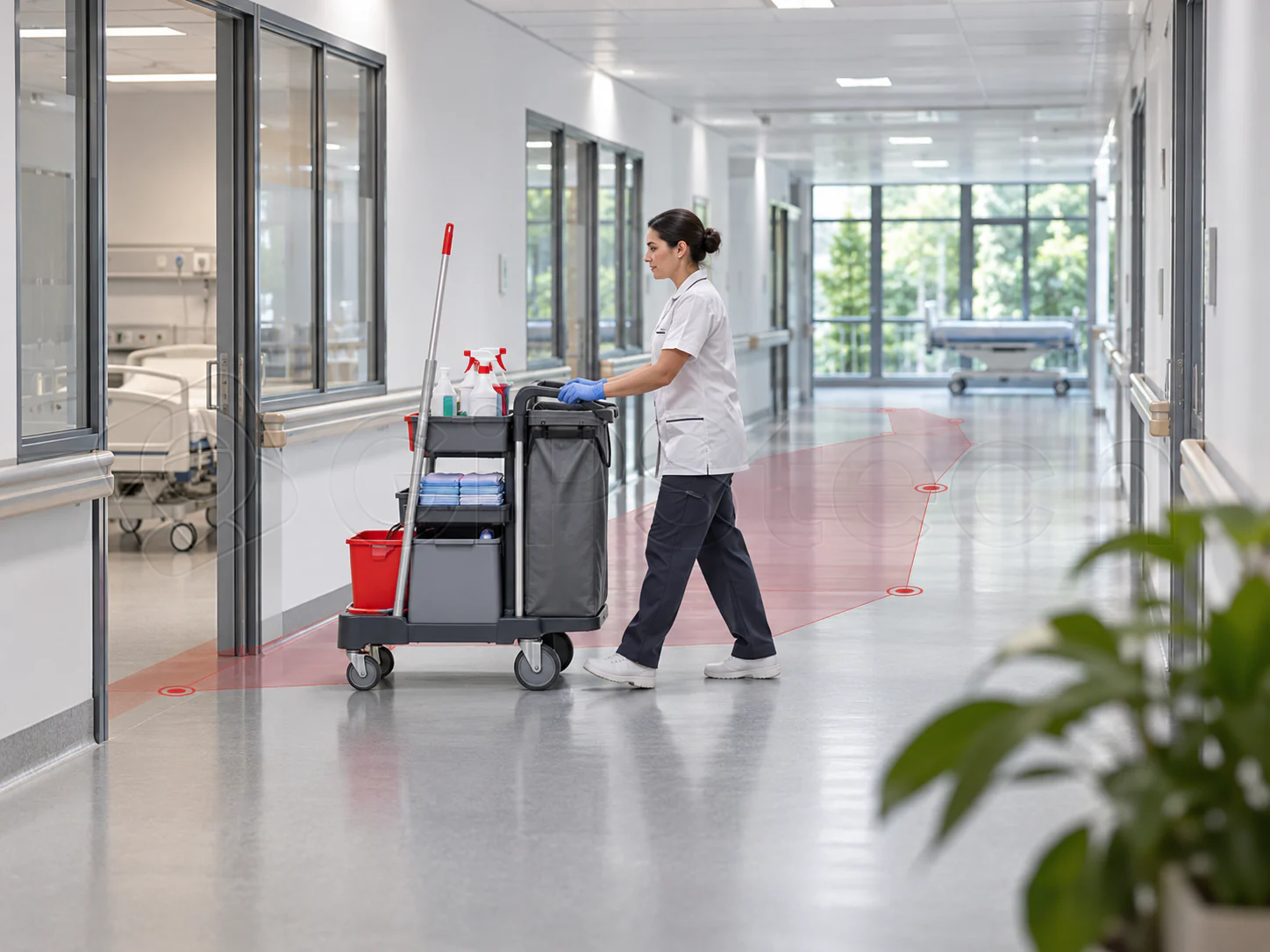
A useful record connects the person carrying out the service, area, interval, activity and outcome. Inaccessible rooms, damaged surfaces and unavailable materials should appear as identifiable exceptions. Checklists and evidence support common terminology provided they do not become a collection of unverified confirmations. The light traces illustrate the concept rather than an automatic certification feature.
Evidence of attendance and quality inspection answer different questions. Even reliable location data establishes spatial context, not correct execution of every operation. Using information about people also requires assessment of privacy and localization.
Check the outcome
Section titled “Check the outcome”UNI EN 13549:2003 (opens in a new tab), listed as current in the UNI catalogue, concerns requirements and recommendations for cleaning quality measurement systems. Citing it does not itself establish a threshold suitable for every building.
An inspection plan identifies what to observe, acceptance criteria, sampling, frequency and responsibility. Samples must be identifiable and findings linked to the inspection time: conditions changed after cleaning can make it inappropriate to attribute every defect to the delivery team. A nonconformity needs a description, corrective action and a subsequent check; sending a photograph alone does not close the issue.
An imaginary example
Section titled “An imaginary example”Aurora outpatient centre distinguishes consultation rooms, routes and washrooms. One room remains occupied beyond the planned time and the team records that access was impossible. The coordinator agrees recovery work while preserving the priority of areas that can be cleaned.
A subsequent inspection finds a defect on a surface and a door still locked. The first case requires repeating the work and inspecting it again; the second requires resolving access. Separating causes makes discussion with the supplier more useful than a single score that conflates both situations. It also allows the next programme to reflect the conditions teams actually encounter.
Healthcare environments and procurement requirements
Section titled “Healthcare environments and procurement requirements”In healthcare environments cleaning and disinfection follow the facility’s specific protocols, competence requirements and assessments. Visual inspection alone does not demonstrate adequate microbiological quality. This article provides no clinical instructions and does not replace those procedures.
For Italian public procurement, the applicable version and scope of environmental minimum criteria, known as CAM, must be checked. Decree 29 January 2021, No. 51 (opens in a new tab) addresses cleaning, sanitation and the supplies identified in its annexes; the Decree of 24 September 2021 (opens in a new tab) amends it. The public-contract framework is Legislative Decree 36/2023 (opens in a new tab), with applicable amendments.
This article is explanatory and does not replace legal or regulatory advice: always check current official texts and procurement documents. For context see healthcare, facility management and GiPStech Asset2Work (opens in a new tab). Reserved pages on service groups and service lines require sign-in.