


 Italiano
An SLA, or Service Level Agreement, describes an agreed service level and how it is verified. A measurable agreement identifies the service, priorities, start and end events, calendar and calculation rules. Writing only “rapid intervention” or “resolution within a few hours” leaves room for interpretations that become especially problematic when service is disrupted.
What needs to be agreed
Section titled “What needs to be agreed”An agreement may govern a supplier relationship or coordinate internal services. Both require a clear outcome: answering a request, accepting responsibility, restoring a function and closing an administrative record are different events. The corrective maintenance process helps distinguish them.
A measurement definition should specify:
- included services, sites and assets;
- priority criteria and who may change a priority;
- the event starting the clock and the event stopping it;
- covered hours, holidays, permitted pauses and their evidence;
- data source, target and review frequency;
- responsibility for checks and dispute handling.
These are agreement choices, not universal values prescribed by the term SLA. Even an identical threshold has different implications when applied to calendar hours or only to covered service hours. All parties need access to the same interpretation before a performance result can be meaningful.
Two durations with the same starting point
Section titled “Two durations with the same starting point”In this article’s example, response time runs from the report to acceptance of responsibility; restoration time runs from the same report to recovery of the function. The resolution marker in the figure represents restoration here, rather than later administrative closure. Both durations use the agreed service calendar.
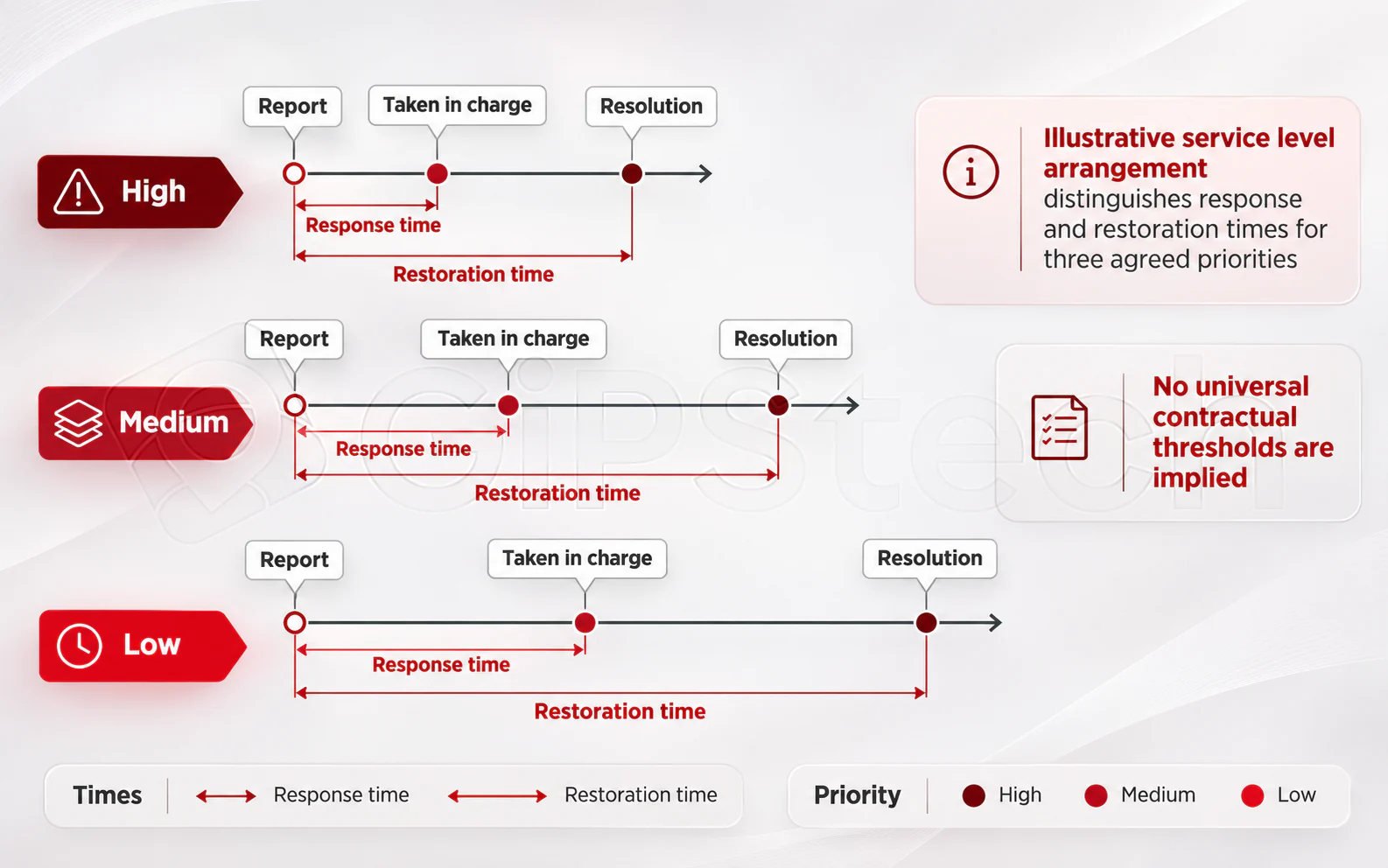
The three priorities illustrate one possible arrangement: shorter targets for more critical events. The contract must establish which consequences determine priority; high, medium and low labels alone do not explain the decision.
An imaginary example
Section titled “An imaginary example”Aurora centre receives a request at 16:30 on Friday. Service covers weekdays from 08:00 to 17:00, with no intervening holidays, and requires a response within two service hours. The deadline is Monday at 09:30: thirty minutes pass on Friday and the remaining ninety on Monday. With continuous coverage, the same threshold would expire on Friday at 18:30.
Responsibility is accepted at 16:45 on Friday and service is restored at 10:00 on Monday. With no pauses, response time is fifteen minutes and restoration time is two hours and thirty minutes under the service calendar. These figures are illustrative, not GiPStech commitments or recommended targets for every context.
Measurement that keeps exceptions visible
Section titled “Measurement that keeps exceptions visible”For a compliance percentage defined over cases resolved in the period, use compliant cases / assessable cases × 100 and state which cases are assessable. Show open cases separately with their age and deadline: silently excluding them can make service performance appear better than it is.
Pauses require a reason, start and end times, and any approval required by the agreement. Retrospective priority or timestamp changes must remain explainable. Averages can hide a few severe delays: supplement summary KPIs with distributions and critical cases.
Checks, penalties and references
Section titled “Checks, penalties and references”A recorded delay does not automatically impose a penalty. Contract rules, responsibility, evidence and any opportunity to respond must be considered. This article is explanatory and does not replace legal assessment of a particular case.
UNI EN 13269:2016 (opens in a new tab), listed as current, guides private maintenance contracts: it does not determine rights and obligations or rules for agreements with public authorities. UNI 10685:2007 (opens in a new tab) concerns results-based maintenance contracts. Continue with outsourced services and GiPStech’s dashboard and SLA page (opens in a new tab): data availability and the specific agreed calculation need separate assessment.